
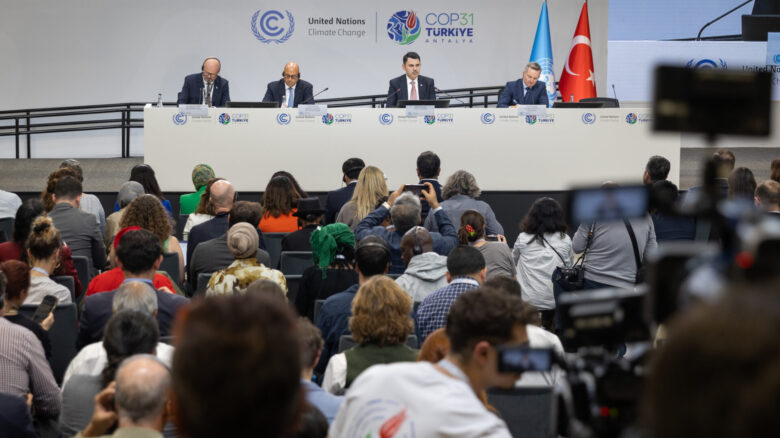
The eleventh day of COP31 was dominated by the new draft cover decision, after Wednesday evening’s Divan failed to produce a breakthrough and negotiators continued working until dawn. The second draft, shortened from 144 to 80 paragraphs, substantially revises the proposals put forward at the beginning of the week. Explicit references to the phase-out of fossil fuels have disappeared, replaced by the broader phrase “transition towards low greenhouse gas emissions and climate-resilient development”. References to the Brazilian roadmaps and the target of at least $120 billion a year for adaptation by 2035 have also been removed, while provisions concerning unilateral trade measures and developed countries’ financial obligations have been weakened. The draft retains the global target of 35% electrification by 2035, acknowledges the risks of overshoot, and includes several proposals to improve access to climate finance. This version of the cover decision will also undergo further revisions, with a series of bilateral meetings between the main negotiating groups and the Presidency. Only a few hours remain before the summit’s scheduled conclusion: without an agreement, negotiations will go into overtime.
Thursday’s thematic focus was implementation and the Turkish concept of “İmece”, meaning cooperation and collective effort to achieve a shared outcome. Events and discussions addressed cross-sector collaboration, scalable solutions, partnerships to implement commitments, and access to finance.
Main facts
Second draft cover decision published: references to fossil fuels and the $120 billion adaptation target disappear. The new draft makes significant changes to several major negotiating issues, scaling back some proposals from the first version while leaving several questions central to the outcome of COP31 unresolved.
- Overshoot and climate ambition. The commitment to limit both the magnitude and duration of overshoot through deep and rapid emissions reductions remains, but the wording explicitly calling for warming to be brought back below 1.5°C as soon as possible during this century has been removed. The proposal calling on developed countries to achieve net-zero emissions by 2030 and net-negative emissions by 2040 has also been deleted.
- Transition away from fossil fuels. All explicit references to fossil fuels have disappeared. Mentions of the Brazilian roadmaps on transitioning away from fossil fuels and on deforestation have also been removed; the first draft had proposed welcoming them as voluntary initiatives. The document retains a general reference to implementing the first Global Stocktake and acknowledges the economic and climate benefits of low-emission technologies, but it does not set out any new explicit political direction on reducing fossil fuel use. Instead, the new paragraph 36 proposes global cooperation on a range of solutions, from renewables and electrification to electricity grids, methane emissions reductions and carbon capture. However, the wording “including through, inter alia” presents these measures as possible pathways to be adapted to national circumstances.
- 35% electrification by 2035. The 35-by-35 initiative is reaffirmed, alongside the goals of tripling global renewable energy capacity and doubling energy efficiency by 2030. However, the target appears in the list of possible solutions in paragraph 36, without specific obligations for individual countries. The question of the electricity mix also remains open: the draft promotes renewables and low- or zero-emission technologies but does not stipulate that increased electricity demand must be met exclusively by renewable sources.
- Adaptation finance. The second draft removes the proposal to set adaptation finance at at least $120 billion a year by 2035, along with the request for developed countries to establish a specific pathway for increasing funding. However, it retains the call to at least triple adaptation finance by 2035, within the framework of the New Collective Quantified Goal on climate finance (NCQG). To make this tripling operational, the draft proposes asking the Standing Committee on Finance to identify possible baselines for the calculation and discussing an implementation pathway under the climate finance work programme (CFWP). Dropping an explicit amount, however, leaves the target’s scale unresolved: without an agreed baseline, tripling could translate into very different funding levels and would not, in itself, ensure adequate coverage of estimated needs.
- Access to climate finance. The draft acknowledges obstacles linked to high capital costs, debt, fiscal constraints, conditionalities and the administrative costs of access procedures. It invites multilateral climate funds and development banks to simplify and speed up approval and disbursement procedures. Annual workshops on access to climate finance are planned from 2027 to 2030, accompanied by technical reports to monitor progress and challenges. The new draft also retains the proposal to launch an Antalya–Addis Ababa roadmap on adaptation and resilience finance, focused on identifying predictable and growing funding sources, innovative instruments and access mechanisms, including resources for loss and damage.
- Trade and unilateral measures. The request for developed countries to eliminate climate-related unilateral measures with trade-restrictive effects by 2027 has been removed, as has the proposal to develop common guiding principles for climate-related trade measures. The text now merely acknowledges concerns over the adverse cross-border effects of such measures, particularly on developing countries.
The Presidency defends the new draft, but Panama threatens to oppose the agreement. At a press conference, the Turkish and Australian Presidencies expressed “optimism and enthusiasm” about progress in the negotiations, pointing to broader areas of consensus and reaffirming their commitment to an ambitious outcome. Responding to criticism over the removal of fossil fuel references, Chris Bowen and Murat Kurum rejected the idea of a “step backwards” compared with the first version, arguing that commitments on the transition had already been made at COP28 and that Antalya’s priority is to turn them into concrete action. From this perspective, according to the Presidencies, the 35-by-35 target would help accelerate electrification and reduce dependence on fossil fuels. Bowen also defended the transparency of the process and pledged that consultations would continue until consensus was reached. Panama took the opposite position, announcing that it intended to oppose a final agreement lacking stronger commitments and calling for a cap on global oil production, more climate finance and faster electrification powered by renewables. In a letter to the Presidencies, Panama stated that it would not endorse an outcome that continued to ignore and justify the individual responsibilities of countries, thereby prolonging and worsening the climate crisis. Overnight, 44 Least Developed Countries (LDCs) also called for the reintroduction of a reference to the phase-out of fossil fuels, the removal of provisions regarding carbon capture, utilization, and storage (CCUS), and the establishment of 2025 as the baseline year for tripling adaptation finance by 2035, in addition to strengthening references to IPCC science.
United States, China and Russia agree to increase oil production. As negotiations continued, Presidents Donald Trump, Xi Jinping and Vladimir Putin met in Shenzhen, China, on the sidelines of the APEC (Asia-Pacific Economic Cooperation) summit, reaching an agreement to increase the production and supply of refined petroleum products. In a joint statement, the three leaders reiterated the importance of ensuring stable energy flows and pledged to strengthen cooperation on United Nations reform and nuclear risk reduction.
Electrification, energy diversification and the Strait of Hormuz crisis: trends from “World Energy Outlook 2026”. At a launch event in Paris, the International Energy Agency (IEA) presented “World Energy Outlook 2026” (WEO), its flagship study of global energy scenarios. The publication examines major energy trends in the geopolitical context of the Strait of Hormuz crisis, described as the most severe disruption to global energy supplies. According to the report, if the interruption to maritime shipping through the Strait persists, oil flows could fall from 20 million barrels per day to 8.5 million in 2030 and to less than 2 million by 2035. The Middle East crisis has also prompted many countries to review their energy strategies to reduce vulnerabilities and improve access to energy. Although national responses differ, “World Energy Outlook 2026” identifies common trends: greater diversification of suppliers, trade routes and energy mixes, increasing reliance on domestically available resources, and a push towards electrification. According to the report, electricity demand is expected to grow even faster through 2035, with electricity’s share of final energy consumption approaching 30% globally across all the scenarios examined. Rising incomes and population growth are also expected to increase global energy demand for transport, heating, cooling and artificial intelligence. The report finds that, as global temperatures rise, energy demand for cooling buildings is surpassing demand for heating them for the first time in history.
Electrification Delivery Package launched. The package brings together new initiatives and updates on electrification projects and involves more than 150 countries plus the European Union, 37 cities and over 260 companies worldwide. Projects included in the package comprise: the construction of more than 21,000 kilometres of electricity grids, announced by the Utilities for Net Zero Alliance (UNEZA); $156 billion in annual investment in grids, renewable energy and storage systems, 5% more than last year and 35% more than in 2024; the operational launch of AMPLIFi, the new Climate Investment Funds financing mechanism designed to electrify developing countries; the creation of 13 zero-emission freight corridors across six continents; and 36 projects worldwide to decarbonise heavy industry.
Key statements
International Energy Agency Executive Director Fatih Birol: “For the first time, energy demand for cooling buildings has exceeded demand for heating them.” Commenting on the main findings of “World Energy Outlook 2026”, published yesterday, Birol said: “The Strait of Hormuz crisis has caused an enormous shock to the system. Although the energy sector and the global economy have shown remarkable resilience, the longer the crisis lasts, the deeper its effects will be. And I see no credible path for the energy world to return to the situation that existed before.” He concluded: “In pursuing greater energy security, countries must be careful not to replace one dependency with another. Nevertheless, it is encouraging for the future that energy security and the energy transition have never been so closely aligned.”
Kiribati’s Minister for Women, Youth, Sport and Social Affairs, Ruth Maryanne Cross Kwansing: “No war has ever been won without reinforcing the front lines: in the fight against climate change, I remind you that we are the front lines.” Kiribati’s message makes clear what is at stake for small Pacific islands: climate action is about being able to continue living on their land, protecting water and food supplies, and preserving communities and cultural identities threatened by sea-level rise. The Minister’s appeal reflects this perspective: “Although we contribute the least to the crisis, we pay the highest price: every fraction of a degree and every delay in funding affect our chances of survival.” This underpins AOSIS’s calls to limit overshoot beyond 1.5°C and make adaptation support operational through immediate, predictable and grant-based funding.
Venezuela’s Deputy Minister for AI and Hydrocarbons, Albania del Mar Villarroel Gomez: “We use AI to make the oil industry greener; we do not want to stop producing hydrocarbons.” The Caracas government official explained that the South American country is using artificial intelligence to make its oil and gas industry more efficient and reduce its environmental footprint. “Our policy is not to stop producing hydrocarbons,” she said. “Our aim is to reduce waste and emissions while continuing to produce energy.” Specifically, AI is being used to monitor emissions, detect methane leaks and improve efficiency in oilfield operations. Villarroel added that the government is focusing on smaller, specialised AI models rather than the energy-intensive, hyperscale systems developed by major technology companies.