
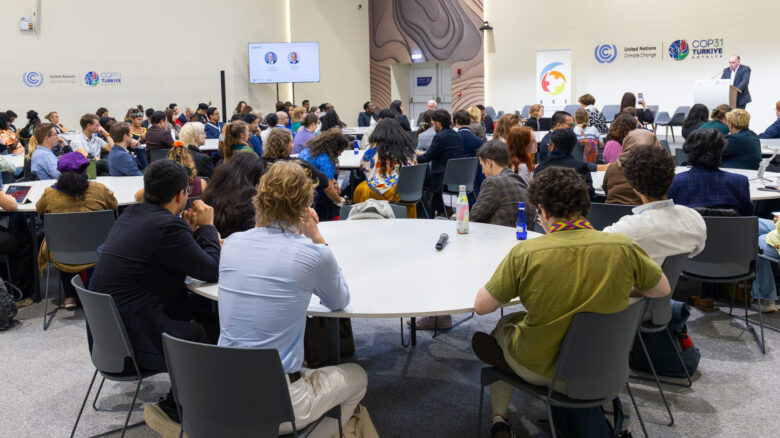
Following Sunday’s rest day, COP31 negotiations resumed in Antalya as the summit entered its second week, which will hopefully lead to the adoption of a text agreed by more than 190 participating countries. Environment and energy ministers have arrived in Türkiye to give fresh impetus to the climate talks. Italy is represented by Gilberto Pichetto Fratin, although negotiations remain under the responsibility of the European Union, with EU Climate Commissioner Wopke Hoekstra.
The first draft of the cover decision was published in the early afternoon: a text bringing together Parties’ different proposals without reflecting a consensus. Until late on Saturday, the Arab Group, Russia and the Like-Minded Developing Countries (LMDCs, including China, India and Saudi Arabia) had challenged the very possibility of adopting a final political decision, arguing that it lacked a legal basis under the United Nations Framework Convention on Climate Change. By contrast, the European Union, the Umbrella Group, which brings together several industrialised countries outside the EU (including the United Kingdom, Canada and Australia), the Alliance of Small Island States (AOSIS) and the Least Developed Countries (LDC) Group had supported the need to adopt a text by Friday that could provide political direction for climate action.
The day focused on science, industry and technology, with events and discussions on scientific innovation, the energy transition in industry, green technologies and sustainable solutions in research and development.
Main events
First draft of the cover decision published. The Australian Presidency released the first draft of the cover decision yesterday: a document comprising 144 paragraphs that translates the different positions gathered during the first week’s consultations into proposals, without yet resolving the main differences. As the accompanying note makes clear, the text does not reflect a consensus: both the wording and the inclusion of individual issues in the final decision remain subject to negotiation. The draft reaffirms multilateralism and the role of the Paris Agreement, acknowledging progress while recognising the inadequacy of current action. It refers to new NDCs submitted by 163 Parties and a warming trajectory of around 2.6°C even with full implementation of national climate plans.
- Overshoot. The text proposes limiting the magnitude and duration of warming above 1.5°C and returning below that threshold as early as possible within this century. Parties are invited to exceed their national targets and revisit and strengthen their NDCs before the second Global Stocktake (2028), linking greater ambition in developing countries to the availability of finance, technology and capacity. Among the most far-reaching proposals is a call for developed countries to reach net-zero emissions by 2030 and net-negative emissions by 2040.
- Transitioning away from fossil fuels. The draft reaffirms the first Global Stocktake’s commitment to transitioning away from fossil fuels in energy systems in a just, orderly and equitable manner, alongside phasing out inefficient subsidies that do not address energy poverty or just transitions. A subsequent paragraph introduces stronger language, calling for accelerated action to phase out fossil fuels. However, it sets no global phase-out timetable. The text also welcomes Brazil’s roadmaps on transitioning away from fossil fuels and halting deforestation, retaining their voluntary and non-prescriptive nature.
- 35% electrification by 2035. The draft includes the Turkish Presidency’s flagship “35-by-35” initiative, which aims to increase electricity’s share of global final energy consumption to 35% by 2035. Contributions would remain nationally determined, without assigning specific targets to individual countries. While promoting clean electrification, the text also recognises potential benefits regardless of the electricity mix, leaving open the question of how to ensure that greater electrification translates into lower emissions.
- Adaptation. The draft seeks to give substance to the commitment to triple adaptation finance by 2035, specifying at least USD 120 billion and calling on developed countries to set out a trajectory for increasing resources. It proposes defining a baseline, interim milestones and monitoring tools, but the figures require clarification: tripling finance would cover no more than 29% of needs estimated at USD 305 billion annually, whereas USD 120 billion would correspond to around 39%.
- Finance. Beyond funding amounts, the document proposes faster approval and disbursement procedures, reaffirms developed countries’ financial obligations and clarifies that aligning financial flows with climate goals must not replace support under Article 9 of the Paris Agreement. It also proposes a new Antalya–Addis Ababa roadmap to identify predictable and growing public sources of finance for adaptation and loss and damage, with findings to be presented at COP32.
- Trade and unilateral measures. One of the most divisive passages calls on developed countries to phase out unilateral climate-related and trade-restrictive measures by the end of 2027 where they have negative spillover effects on international cooperation. The draft also proposes assessments of impacts on developing countries and common principles on non-discrimination, transparency and interoperability.
Many Parties reject the draft and call for a more focused text. Initial consultations highlighted an extremely long and heterogeneous text that brings together proposals that are difficult to reconcile. Some delegations are therefore calling for greater concision and coherence, avoiding duplication with other negotiations, while the African Group also criticised the lack of clarity in the process. Several Parties nevertheless welcomed the availability of a draft early in the week. The Presidency defended this approach as a way to give delegations time to examine it before ministers arrived, while aiming to present a shorter and more focused version by midweek. The Arab Group, the LMDCs and Russia, however, rejected the text in its entirety, challenging new mandates, sectoral targets and “top-down” provisions on energy sources, which they consider incompatible with nationally determined pathways. Burkina Faso raised a significant concern about effectiveness: a draft dominated by weak language risks failing to deliver the concrete outcomes expected from the “COP of implementation”.
Climate finance: the Global South calls for an operational work programme amid tensions over the no text option. Established at COP30 in Belém through the Mutirão Decision, the two-year climate finance work programme is to address Article 9.1 of the Paris Agreement — the obligation of developed countries to provide resources to developing countries for mitigation and adaptation — in the context of Article 9 as a whole. For the G77 and China, the programme must be launched at this COP with clear guidance on its scope, operational modalities and workplan. The Arab Group insists on the centrality of Article 9.1 of the Paris Agreement, which requires developed countries to provide financial resources to developing countries: raising the latter’s ambition, it stresses, requires adequate means of implementation. AOSIS, AILAC and the Least Developed Countries (LDCs) share similar demands: the programme must produce negotiated outcomes and practical support, rather than being limited to dialogues or exchanges of information. Adaptation, including the tripling of finance, emerges as a shared priority. The European Union is willing to discuss implementation of Article 9 as a whole, but rules out reopening elements of the New Collective Quantified Goal on Climate Finance (NCQG) agreed in Baku. Differences therefore remain over both the programme’s scope and the outcomes it should deliver. Towards the end of the meeting, the EU’s request to add a no text option sparked strong indignation among Global South delegations, with the Arab Group and the LMDCs openly opposed. Including this option would allow for no new provisions to be adopted at this COP on scope, modalities and the workplan: it would not automatically abolish the programme established in Belém, but would leave operational questions unresolved. It is precisely this risk of delay that runs counter to the Global South’s demand to move from commitments to practical implementation.
The COP31 Presidency launches a package of initiatives on artificial intelligence, green industrialisation and climate technologies. On artificial intelligence, the Antalya Artificial Intelligence Pledge invites governments and businesses to set out the actions they will take to use AI in support of climate goals, while the AI-Enabled Cleantech Initiative supports pilot projects applying AI to clean technologies. Industry, responsible for around a quarter of global emissions, is the focus of the Antalya Green Industrialisation Compact, which aims to promote investment and practical measures for zero-emission production. Finally, the Least Developed Countries Green Industrialisation Facility (LDC-GIF) aims to support green industrialisation in the least developed countries by facilitating technology transfer.
Key statements
Simon Stiell, UNFCCC Executive Secretary: “AI and other frontier technologies are a double-edged sword.” Artificial intelligence and its application in tackling climate change are central to the debate. “AI and other frontier technologies are a double-edged sword. Our task is to mitigate the dangers, unlock their catalytic potential and use these technologies responsibly,” Stiell said. “The benefits of AI must outweigh its ever-growing costs. And those benefits must reach every country.”
Chris Bowen, President of Negotiations: “We believe the draft cover decision provides a very good basis for conversations over the next four days.” At a press conference, the Australian Minister discussed the draft document circulated in the early afternoon as a starting point for negotiations. He did not conceal the differences between countries’ positions: “There are elements in this draft cover decision that not all Parties will agree on. That is a given. In the coming days, we will concentrate on those issues where common ground can be found.”
Mia Mottley, Prime Minister of Barbados: “The cancer of indifference to the climate crisis is pushing the world ever closer to the brink.” Mottley stressed the urgency of tackling emissions, particularly non-CO₂ gases: “If we can control methane, we can reduce the temperature rise by 0.3°C to 0.5°C; we can buy time to continue decarbonisation.” She then criticised some countries’ indifference to the climate crisis, which she warned was driving the planet towards disaster: “We need to break down the crisis into simple, everyday language so that people understand what is at stake, whether through their silence, their inaction or even their actions.”