
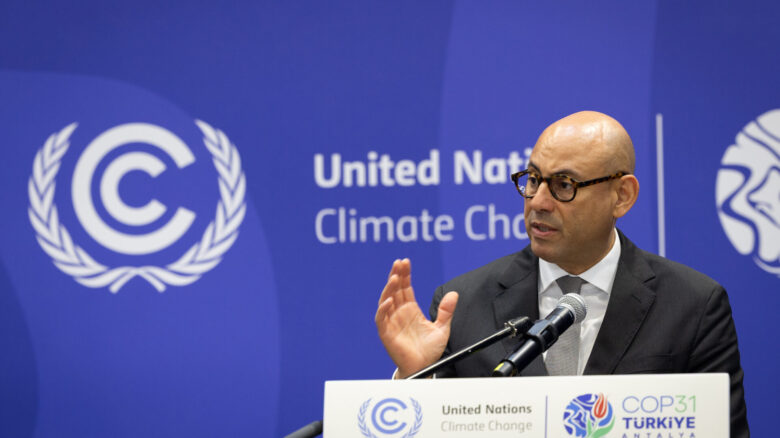
The tenth day of COP31 has come to an end, bringing to a close the two days of the high-level segment devoted to national statements, during which more than one hundred government representatives took the stage in Antalya. According to the summit’s official schedule, only two days remain to find a solution agreed upon by the more than 190 participating countries, but the possibility is already emerging that this COP, too, will go into overtime: the last to conclude on schedule was COP9, in Milan in 2003.
To bridge the still divergent positions on the cover decision and the main issues on the table (electrification, transition away from fossil fuels, climate finance, overshoot), the Turkish Presidency has convened an informal negotiation, bringing together ministers and high-level delegates to work out a solution. The meeting is called “Divan” and takes its name from the council of officials responsible for the administrations of the Ottoman Empire, who gathered around the Sultan to discuss and decide. The aim is to seek a compromise that can win the approval of the Parties and lead to a second draft of the final document, following the one released on Monday, which was simply a compilation of the countries’ various requests. The new draft cover decision is expected to be released today.
The day’s thematic focus was on social development and gender issues, with particular attention to inclusive climate action, community resilience, public health, women’s empowerment and the just transition.
Main facts
Second Global Stocktake launched. At a high-level ministerial event, the second Global Stocktake was launched. This periodic global assessment, provided for under Article 14 of the Paris Agreement, takes stock every five years of progress made worldwide in addressing the climate crisis (adaptation, mitigation and finance). This second exercise will conclude at COP33 in 2028, for which a host country has yet to be determined. The process begins with the collection and preparation of information, which will provide the basis for the technical assessment, scheduled to begin next year. It will finally conclude with an overall assessment of the results.
IPCC, EU seeks agreement to avoid delays. The timetable for the IPCC’s “Seventh Assessment Report” (AR7), established by consensus among countries, remains at the centre of a political debate that risks depriving the second Global Stocktake of an up-to-date scientific basis on impacts, adaptation and emissions reductions. India and Saudi Arabia are calling for more time to allow authors and governments in developing countries to review the texts, which they consider too closely tied to analyses conducted by advanced economies: their proposal envisages publishing the contribution on the physical science basis of climate change by 2028, while postponing those on impacts and adaptation, and on mitigation, until 2029. The EU and numerous vulnerable countries, by contrast, support a timetable that would allow these contributions to inform the next global stocktake under the Paris Agreement. The issue, therefore, concerns a timetable that has yet to be agreed, not a delay that has already been formally decided. To break the deadlock, European delegations are seeking China’s support: Wopke Hoekstra described discussions with Beijing as constructive, reiterating that climate decisions must be grounded in science and that the next Global Stocktake needs the IPCC’s assessments. Brussels also intends to pursue this approach in its dialogue with Saudi Arabia: referring to the planned meeting with the Saudi delegation, the Commissioner stressed the need to “build bridges with those who hold different views”, pointing to diplomacy as the means to reach an agreement.
Transition away from fossil fuels: national roadmaps on the rise, but operational plans now needed. An increasing number of governments intend to turn the commitment to transition away from fossil fuels into national pathways. New commitments have been announced by Spain, Portugal, Luxembourg and Pacific countries, alongside initiatives already undertaken by France, Germany, Finland and the Netherlands. Denmark has presented its roadmap, combining an end to oil and gas production with the expansion of renewables, electrification and carbon pricing. Portugal, meanwhile, aims to achieve climate neutrality by 2045 and halve its dependence on fossil fuels by 2034, focusing primarily on transport, industry and buildings. The political objective is to follow through on these pathways in the cover decision as well: governments are asking the Presidencies to turn the recognition of roadmaps into concrete support for their implementation, linking electrification to the transition away from fossil fuels. However, the question of their “robustness” remains: as Climate Analytics stressed at a press conference, the plans presented are a positive signal, but they must be backed by detailed measures and clear implementation pathways.
EU, climate leadership put to the test by finance. With the United States absent from the negotiations, the European Union is being called upon to demonstrate its ability to build consensus, especially with the most vulnerable countries. This is where civil society criticism is focused: at a Climate Action Network (CAN) press conference, Brandon Wu, director of ActionAid USA, noted that, with Washington no longer at the table, developed countries can no longer blame the United States for obstacles in the negotiations. Criticism centres on the EU’s decision not to announce new funding at COP31 and its resistance to implementing commitments on finance and the just transition. The contributions provided by developed countries for adaptation were described as “crumbs”, amid warnings that the discussion on tripling funding risks being continually shifted from one forum to another without delivering results. The EU was also accused of obstructing the just transition mechanism and the finance work programme (CFWP), including by proposing a no-text option. Wopke Hoekstra rejects the criticism, pointing to European contributions: in 2025, the EU and its Member States recorded €32.3 billion in public climate finance, including bilateral commitments and multilateral disbursements, and €9.3 billion in private finance mobilised. Of the public funds, 48% supports adaptation or combined activities, and 41% is provided as grants (the figure includes bilateral commitments and multilateral disbursements and therefore does not entirely represent amounts already paid out). The Commissioner reiterates the commitment to engage other contributors and, above all, ensure that resources reach the countries that need them: accessibility of funds remains central to the criticism directed at Brussels. On trade, MEP Lidia Pereira defended CBAM as a climate measure (rather than a trade measure), designed to encourage cleaner production in partner countries. Questioned about the associated revenue for the EU budget, she clarified that, “ideally”, the EU would prefer to collect nothing, because that would mean, in her words, that “other countries produce cleanly”.
Adaptation Fund: approximately $50 million pledged. Six countries announced contributions to the Fund: Spain ($27.8 million), Germany ($11.1 million), Ireland ($6.7 million), Belgium ($2.9 million), Portugal ($1.1 million) and Estonia ($334,000). The pledges remain far short of the target of mobilising at least $1.2 billion over the entire 2026–2029 period. The Fund supports adaptation projects and programmes targeting the most vulnerable communities in developing countries.
Climate and gender issues. A high-level event examined the just transition from a gender perspective and took stock of progress under the Gender-Responsive Just Transitions and Climate Action Partnership. Launched at COP28, the initiative seeks to harness women’s potential as active agents in tackling climate change. The United Nations report on gender equality, “Progress of the World’s Women 2026: Gender Equality in the Age of Climate Crisis”, was also presented. According to the report, more than one in three women (1.5 billion people) live in areas of high climate risk, characterised by exposure to environmental hazards and deep gender inequalities. Moreover, the climate crisis could push an additional 141 million women and girls into extreme poverty by 2050.
Five new Italian infrastructure projects in Africa and Central Asia. The Ministry of the Environment and Energy Security presented in Antalya the five projects selected under the Nature-based Solutions Innovation Accelerator (NBS-IA), a global initiative promoted by the ministry in collaboration with UNEP and the OECD. The selected projects concern port and logistics infrastructure in Mozambique, Kenya and Algeria; water infrastructure along the Isfara River corridor in Uzbekistan; and urban infrastructure in Astana, Kazakhstan.
Key statements
Mohammad Ayoub, Saudi negotiator for the Arab Group: “Calling on developed countries to disburse funds is not pointing fingers: it is respecting the Paris Agreement.” The negotiator is a regular voice in the climate finance debate: during discussions among heads of delegation on the implementation of Article 2, paragraph 1(c), and Article 9.1, the Arab Group expressed “deep regret” that funding for developing countries was still being debated. He added that discussions on climate finance and the related Work Programme seem to repeatedly stall and get bogged down in administrative details that should already have been resolved.
China’s climate envoy, Liu Zhenmin: “Implementation of the Paris Agreement is already underway and cannot be reversed halfway through.” In an interview given in Türkiye, the representative of the Beijing government reaffirmed China’s commitment to implementing the Paris Agreement: “The Agreement’s goals are being implemented and cannot be changed, nor can we turn back halfway through.” He added: “Insufficient funding for developing countries affects the pace of their energy transition, their ability to adapt and their capacity to respond to disasters.” Finally, he stressed that the absence of the United States from the summit had left a leadership vacuum in climate action: “After the withdrawal of the United States, the EU and other developed countries were also unprepared to fill the vacuum that was created.”
Catarina Nefertari, Amazonian activist: “Children are growing up while the world continues to negotiate.” Originally from Belém and leader of the Amazônia de Pé movement, Nefertari is attending COP31 with the mothers’ delegation from Our Kids’ Climate. “I was born in 1997, the year of the Kyoto Protocol. My daughter Helena was born in 2015, the year of the Paris Agreement,” she said, recalling how extreme heat and smoke from wildfires affect the daily lives of children in her community. While acknowledging the value of international cooperation, she is calling for commitments to translate into better living conditions and for parents and caregivers to have a greater voice in the negotiations: “As a mother, it weighs heavily on me to see how slowly change is happening, when childhood cannot wait.”