
The first week of COP31 has come to a close. Following Friday’s publication of the Presidency’s informal note summarising the different positions expressed by countries, an extraordinary negotiating session was held on Saturday to accelerate consultations and produce a first draft of the cover decision by Monday, alongside the other negotiating texts on the table. Meanwhile, new drafts on the Adaptation Fund and the Mitigation Work Programme were released early on Saturday, showing that Parties remain far apart across the negotiating agenda. As negotiations continued inside the conference venue, civil society took to the streets on Saturday afternoon to demand more ambitious and equitable climate action.
Ministers representing national governments will arrive for the second week of the summit, including Italy’s Minister of the Environment and Energy Security, Gilberto Pichetto Fratin. Alongside the negotiations, the final day of the first week focused on children, youth, education and skills. Discussions centred on strengthening young people’s role in tackling climate change, raising environmental awareness, integrating climate issues into education and involving future generations in sustainable development.
Main events
Adaptation Fund: the transition to the Paris Agreement brings funding back into focus. Negotiations at COP31 continue on enabling the Adaptation Fund, established under the Kyoto Protocol and already serving the Paris Agreement, to serve the latter exclusively. The transition is linked to the availability of the share of proceeds earmarked for adaptation under the Article 6.4 carbon market mechanism. These revenues would complement the voluntary public and private contributions that finance the Fund. To unlock the transition, the African Group has proposed authorising the Fund’s Board to finalise the necessary legal and institutional arrangements with the World Bank, which acts as its trustee. The Board’s composition also remains contentious: the Like-Minded Developing Countries (LMDCs) want to retain its current membership structure, while Japan challenges representation based on categories inherited from the previous negotiating framework. On finance, the G77/China is calling for a concrete outcome, stressing the Fund’s importance in providing developing countries with grants that do not add to their debt. The institutional transition must therefore be accompanied by adequate and accessible resources: the start of carbon market revenues alone will not resolve the problem of insufficient contributions and outstanding pledges.
Mitigation: divisions persist over the duration and role of the work programme. Negotiations remain open on the future of the Mitigation Work Programme (MWP), established to scale up ambition and the implementation of emissions reduction measures through technical dialogues and investment-focused events. The European Union and Mongolia propose extending it until 2040, while Japan and Norway support continuation beyond 2030. The Arab Group, the African Group and Malaysia favour an end date of 2030. Differences also concern its relationship with the Global Stocktake (GST), the periodic assessment of collective progress towards the Paris goals: the EU considers complementarity with the GST an integral part of the programme’s mandate, while Russia opposes references that would steer its work according to the stocktake’s outcomes. Underlying these discussions is the debate over how far the MWP should guide national action: several developing countries want to preserve its non-prescriptive nature, avoid new targets and secure the finance and capacity needed to implement existing commitments. The discussion is therefore about both how long the programme should continue and how to make it more useful in reducing emissions while respecting different national circumstances.
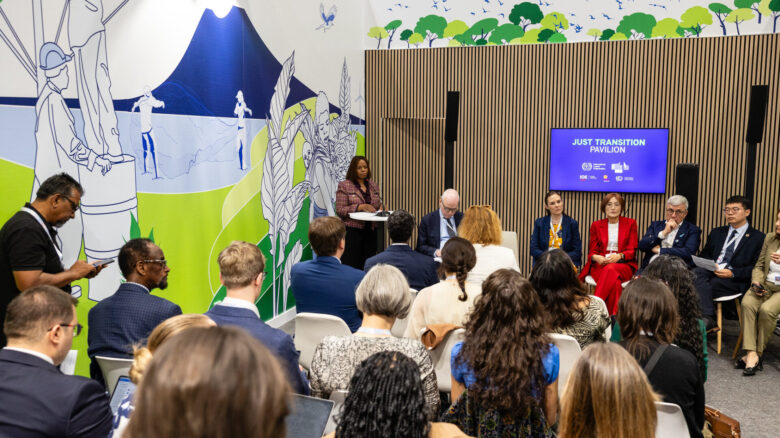
Just transition: Parties remain far apart on implementing the Belém–Antalya Mechanism. Negotiations to operationalise the just transition mechanism (BAM), established at COP30 to support countries and workers as economies transform, are progressing slowly. The text still contains 43 sets of square brackets and 16 alternative options, reflecting the many unresolved issues. Some convergence is emerging around a structure with two components, one providing political guidance and the other focused on implementation. However, the future of the existing Just Transition Work Programme remains undecided: it could continue or be absorbed into the new mechanism. Civil society organisations are particularly critical of the weakness of the implementation component. The second week will therefore need to clarify how to turn the BAM into effective support for the transition.
Chile, Lebanon, Mexico and Zambia join the Climate Implementation Bridge. The COP31 Presidency’s platform was established to help participating countries navigate the difficult transition from climate commitments on mitigation and adaptation to practical implementation. They join Ethiopia, Fiji, Indonesia, Pakistan and Uzbekistan, the initiative’s first group of participating countries. BRIDGE draws on the United Nations’ Climate Promise: Forward project, which provides a common framework to help governments translate national climate priorities into a pipeline of bankable projects. Türkiye has pledged USD 3 million to the project.
Brazil commits to hosting an international conference on transitioning away from fossil fuels. President Luiz Inácio Lula da Silva made the commitment during a meeting with civil society, responding to a proposal by Marcio Astrini, Executive Secretary of the Observatório do Clima: “We will do it; we have a moral obligation.” The announcement signals an intention to build on the work launched in Belém, although the timing and format of the event remain to be determined. The proposal comes amid growing international debate on reducing dependence on coal, oil and gas. Following the first conference organised by Colombia and the Netherlands in Santa Marta in April 2026, attended by 57 countries, a second edition is planned in Tuvalu in 2027, in partnership with Ireland. It has not yet been formally confirmed whether Brazil will host the third conference in this process.
Key statements
Denise Cauchi, CEO of Climate Action Network Australia: “Giving a mechanism responsibilities without the means to carry them out will leave workers and communities waiting for help that will never arrive.” Speaking at the press conference, Cauchi criticised the first draft of the Belém–Antalya Just Transition Mechanism (BAM), calling for an institution capable of mobilising resources and connecting those who need support with those who can provide it. Meaningful civil society participation in decision-making is also essential: “Communities need a seat at the table.” Cauchi urged negotiators to strengthen the text: “Civil society will not accept the lowballing of ambition in these negotiations. We have a week to go. Let’s roll up our sleeves and get it done.”
Simon Stiell, UNFCCC Executive Secretary: “We can only win this global climate fight if we get better at enlisting billions of people.” At the press conference marking the end of the summit’s first half, Stiell urged countries “to move swiftly to the hardest issues and to avoid tactical delays”, referring to obstruction by some countries during consultations on the cover decision. “There’s no climate quick-fix. No single COP can magic this crisis away. We can only win this global climate fight if we – in the climate community – get better at enlisting billions of people. To do that, we need to meet people where they are at, in their everyday lives,” he added.
Murat Kurum, COP31 President: “There is no national competition on climate: issues such as water and climate risks know no borders.” The Turkish minister also addressed the conference, stating: “Countries must protect their national interests, but there is no competition when it comes to issues that transcend borders, such as water, food and climate disasters. Finding common ground is in everyone’s interest.” He concluded by calling on countries to make “Antalya a symbol of the shift from promises to implementation”.