
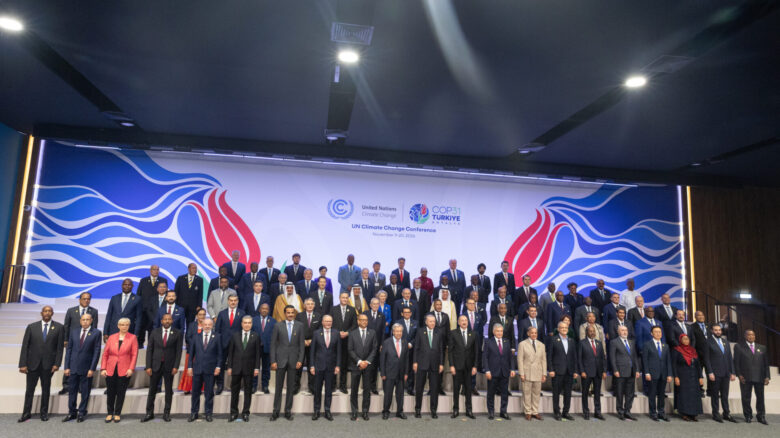
It is the third day of COP31 in Antalya and the first of the two days of the Leaders Summit, the high-level meeting bringing together heads of state and government to discuss the theme Towards a Sustainable, Resilient and Equitable Future. Leaders are being called upon to outline their countries’ climate priorities, announce national commitments and hold bilateral talks to shape the positions they will take during negotiations, particularly on the energy transition and climate finance.
There are many notable absences: Chinese President Xi Jinping (represented by Vice-President Han Zheng), Indian Prime Minister Narendra Modi and, of course, US President Donald Trump have not travelled to Türkiye. Having decided to withdraw the US from the Paris Agreement, Trump has chosen, for the second consecutive year, not to send a government delegation to the conference. Despite the absence of a US federal delegation, participation by local administrations demonstrates the willingness of part of the country to maintain international dialogue, even with Washington’s disengagement.
Many European leaders are also absent: Italian Prime Minister Giorgia Meloni (Minister of the Environment and Energy Security Gilberto Pichetto Fratin will fly to Türkiye), German Chancellor Friedrich Merz, French President Emmanuel Macron and Spanish Prime Minister Pedro Sánchez are not attending the summit. Most European Union leaders have preferred to attend two political meetings taking place in Dublin these days: the European Political Community summit and the informal European Council, dedicated for the first time to artificial intelligence. European Commission President Ursula von der Leyen took the COP31 stage to represent them. Those attending include, in addition to Recep Tayyip Erdoğan, president of the host country, the newly re-elected Brazilian head of state Luiz Inácio Lula da Silva, British Prime Minister Andy Burnham – the only leader of a G7 country to attend the summit – and Iranian President Massoud Pezeshkian. In terms of the thematic focus, the third day of the conference addressed zero waste, with particular reference to circular economy policies, resource efficiency and green value chains.
Main facts
Cover decision: first draft expected early next week. Australian Minister for Climate Change and Energy Chris Bowen announced that an initial draft of the cover decision would circulate from the first few days of next week. Consultations with Parties will continue until Friday, with the aim of issuing an initial synthesis by Saturday evening.
Many issues are on the table: exceeding the 1.5°C threshold (overshoot), the gap between national climate commitments (NDCs) and the policies needed to deliver them, the transition away from fossil fuels, climate finance, adaptation measures and compensation for loss and damage. Differences remain over the presidency’s mandate, challenged by Russia, and over targets for individual sectors, such as energy and transport, opposed by the Arab Group and the Like-Minded Developing Countries (LMDC). The African Group, meanwhile, is calling for negotiated outcomes to take precedence over the presidency’s voluntary and political initiatives.
This work forms part of the vision Bowen set out in plenary: the partnership between Türkiye and Australia connects the Mediterranean and the Pacific, but has a global mission, in a context marked by growing pressures on the energy system and climate impacts that are already tangible. For countries such as Tuvalu, he recalled, the very possibility of continuing to live in their own territory is at stake. Hence the three priorities identified: accelerating electrification wherever possible, strengthening adaptation and ensuring timely, systematic and equitable climate finance. Translating these priorities into practical and inclusive solutions will require a willingness to listen, cooperation and negotiating skills.
On this front, the high-level dialogue dedicated to the “35 by 35” target brought electrification to the centre of the Leaders Summit, where it emerged as a lever for strengthening energy security and fostering sustainable economic development, especially in countries heavily dependent on fossil fuel imports. Expanding the supply of clean, affordable and reliable electricity can support productive sectors and accompany changes in consumption in transport, buildings and heating. Realising this potential requires simpler regulatory procedures, technical skills, exchanges of know-how and investment in grids and storage, supported by grants and concessional finance.
Exceeding 1.5°C is inevitable but reversible. Exceeding the threshold of 1.5°C of global warming above pre-industrial levels is now inevitable, but its magnitude and duration will depend on government choices. This is the message of the report “Climate overshoot: The way back below 1.5°C”, published by Climate Analytics: with maximum climate ambition, it would be possible to limit peak warming to around 1.7°C towards the middle of the century and bring temperatures back to 1.2–1.3°C by 2100. This pathway requires halving fossil fuel use by 2035, accelerating renewables, electrification and efficiency, reducing emissions of methane, halting deforestation and increasing CO₂ removal from the atmosphere. World Meteorological Organization Secretary-General Celeste Saulo also stressed the urgency, highlighting the accumulation of greenhouse gases in the atmosphere, ocean warming and melting glaciers. The prospect of further warming linked to El Niño reinforces the need to combine emissions cuts with early warning systems and measures to protect communities.
Mitigation: strengthening implementation while respecting the programme’s mandate. During the consultation on the Sharm el-Sheikh Mitigation ambition and implementation Work Programme (MWP), established at COP26 and operationalised at COP27, many Parties insisted on the need to preserve its non-prescriptive and non-punitive character, taking into account different national circumstances. The Arab Group, represented by Saudi Arabia, together with Egypt and Oman, rejected approaches that could reinterpret the existing mandate, introduce new targets or create additional obligations. Egypt specified that the MWP must not become a forum for discussing or renegotiating sovereign targets contained in NDCs. South Africa also stressed the centrality of NDCs and the absence of any need for new structures. From this perspective, the programme must accelerate ambition and implementation through the exchange of experiences, the identification of barriers and links to concrete solutions: accessible finance, technology transfer, capacity-building and collaboration with experts and financial institutions. Access to these means emerges as common ground across numerous interventions, albeit with different emphases: India highlights developed countries’ financial obligations, Nepal calls for support without further debt for countries facing difficulties, and The Gambia for greater community participation. Differences remain over duration: small island states and South Africa support continuation until 2030, Peru proposes going beyond that date without an end date, while Egypt identifies 2030 as the maximum limit. The discussion therefore concerns how to make the MWP more effective in supporting national choices, without turning it into a mechanism that dictates what those choices should be.
Towards COP32: Ethiopia focuses on anticipatory action and predictable finance. Ethiopian Prime Minister Abiy Ahmed identified protecting the most exposed communities as a priority for the next conference. Ethiopia is using artificial intelligence and satellite data to improve forecasts and provide farmers with timely warnings, but anticipating risk is useful only if people have the resources to act. Hence the call for clear financial commitments on three aspects: how much funding will be available, by when and on what terms. Ahmed also called for deeper emissions cuts and pledged close cooperation with the COP31 presidency to ensure continuity with the outcomes of Antalya. The aim is to deliver support before extreme events turn into disasters, reaching the most vulnerable communities first. “Our farmers once trusted the seasons to arrive on time. Let us make sure our support does too”, he concluded.
Climate performance ranking: Italy rises to 41st place but remains in the low category. Italy gains five places compared with last year in the Climate Change Performance Index (CCPI 2027), published by Germanwatch and NewClimate Institute, but retains a low overall rating. Presented at COP31, the index compares 64 countries and the European Union as a whole. The assessment combines 14 indicators across four categories: greenhouse gas emissions, which account for 40% of the score, and renewable energy, energy use and climate policy, each weighted at 20%. The comparison considers both the results achieved and the consistency of targets with the Paris Agreement. The top three places remain vacant, because no country performs well enough to receive a “very high” overall rating. Denmark therefore leads the ranking in fourth place, followed by Lithuania and Luxembourg in fifth and sixth place respectively. The European Union ranks nineteenth, in the medium category. Italy’s recovery should therefore be read as a relative improvement in the ranking, rather than the achievement of performance adequate to meet climate goals.
After the Amazon, forests return to centre stage. During the Leaders Summit Event on Forests, eight philanthropic organisations announced an investment commitment of US$85 million to the Tropical Forest Forever Facility (TFFF). Launched in Belém, the mechanism aims to make tropical forest conservation economically attractive by providing countries with annual payments financed by investment returns. At least 20% of national payments are earmarked for Indigenous Peoples and local communities. The announcement accompanies the roadmap to halt and reverse deforestation by 2030, presented by the Brazilian COP30 presidency. The voluntary document, which has not been subject to negotiation, organises action into five areas: conservation, sustainable management and the bioeconomy, reducing degradation, combating deforestation and forest restoration.
Key statements
European Commission president Ursula von der Leyen: “Double down on climate efforts: the EU will do its part”. Von der Leyen, in Antalya representing the European institutions, wrote on X: “The world is at a turning point. We are on track to exceed the 1.5°C goal and every fraction of a degree counts”. She also urged leaders to “double down on our efforts. And Europe will fully play its part”.
Australian prime minister Anthony Albanese: “We have a responsibility to act for future generations”. The head of government in Canberra recalled how the effects of climate change can be particularly burdensome for future generations: “We have a solemn responsibility, to this generation and those to come, to act” to tackle the climate crisis. “COP31 must be the moment when our cooperation delivers concrete results: unlocking investment in clean energy technologies, accelerating electrification, driving action for our oceans and unlocking climate finance for those who need it most”.
Brazilian president Luiz Inácio Lula da Silva: “We talk more about weapons and tariffs than the survival of future generations”. The recently re-elected Brazilian head of state is among the few global leaders to have spoken in Antalya, one year after the COP in Belém. “Since the beginning of this year, climate change has disappeared from the speeches and documents of world leaders. At the G7 and G20 summits, forums that bring together those most responsible for global greenhouse gas emissions, concern has given way to silence. More is said about weapons and tariffs than about the survival of future generations”, he stated. “The energy transition has begun to be seen by some as an obstacle to security”. He then added that his country would continue to do its part to move away from fossil fuels and limit deforestation. “Brazil is back to defend the preservation of a healthy planet”, he concluded.
Pakistani prime minister Shehbaz Sharif: “Light up our homes without darkening the planet”. At the high-level event on the “35 by 35” target, Sharif highlighted Pakistan’s progress in the energy transition, citing the addition of 22 GW of rooftop solar PV capacity in two years and the growth of clean sources, which now contribute around half of the country’s electricity generation. On transport, he pointed to the goal of promoting electric mobility by 2030, including through tariff concessions.