
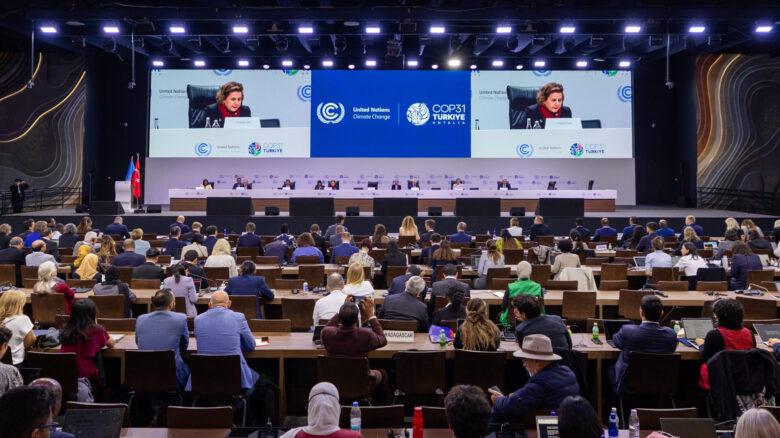
In Antalya, following the adoption of the official agenda, COP31 proceedings are getting into full swing. The second day focused on energy and transport, with particular attention to energy security and efficiency, electrification, grid infrastructure and zero-emission mobility. These are fundamental issues for the Turkish presidency, which has launched a series of initiatives aimed at supporting and promoting electrification, including its flagship “35-by-35” project. President of Negotiations Chris Bowen emphasised its ambition, noting that this share currently stands at just 23%: “Reaching 35% will require an enormous effort, but we must do it”. For Bowen, accelerating electrification is a necessary condition for staying on a pathway compatible with the 1.5°C goal. Speaking during the plenary, Brazilian Environment Minister Marina Silva stated that electrification is a concrete opportunity, but must come from clean sources. No country can undertake this transformation alone: cooperation, technology sharing and the mobilisation of public and private capital are needed to support a just and planned transition.
Main facts
From fossil fuels to the transition: TAFF Mutirão, the Brazilian roadmap. During the plenary, the Brazilian COP30 presidency presented the TAFF (Transitioning Away From Fossil Fuels) Mutirão roadmap, announced at the close of the previous COP. The roadmap proposes a pathway to implement the commitment made at COP28: transitioning away from fossil fuels in energy systems in a just, orderly and equitable manner, accelerating action in this “critical” decade towards net zero emissions by 2050.
André Aranha Corrêa do Lago traced the initiative back to the proposal by Brazilian Environment Minister Marina Silva and highlighted contributions from organisations such as the International Renewable Energy Agency (IRENA) and the International Energy Agency (IEA). The shift from negotiations to implementation, he stressed, makes it possible to involve a broader range of actors, beyond the governments sitting at the negotiating table. The document is the outcome of a consultation process that gathered 267 submissions, including those from 115 Parties and negotiating groups.
It is not a negotiated decision and introduces no new national obligations or deadlines: it offers tools that governments and productive sectors can use to identify their priorities and build transition pathways, in a context where, as reiterated by United Nations Secretary-General António Guterres, dependence on these fuels exposes economies to shocks and high costs. There is, however, no single pathway for all: capacities and starting conditions differ, but there is a common direction.
Reducing dependence on fossil fuels requires simultaneous action on energy demand, supply and the structure of the economy. On the first front, this means limiting the use of coal, oil and gas in transport, buildings and industry through electrification wherever possible. On the second, fossil fuel supply must be reduced and low-emission energy systems expanded, ensuring energy reliability and affordability. The third concerns the economic conditions for the transformation: incentives, investment, economic diversification and protection for the workers and regions most dependent on fossil fuel activities. To translate this approach into operational choices, the roadmap introduces the Belém Readiness Approach. Each country is invited to assess two dimensions in each of the three areas: exposure to the transition, meaning the scale and complexity of the changes needed, and the capacity to implement them, in terms of resources, technologies and enabling conditions.
The combination of these dimensions identifies the national profile, which corresponds to different priorities for action: the Belém Readiness Tripod then brings together the three assessments, helping to identify where obstacles are concentrated and where finance and technical assistance should be directed.
The agenda proposes three phases: by 2028, strengthen planning and institutions, reform fossil fuel incentives while protecting vulnerable consumers, and reduce methane emissions; in 2029–2030, accelerate electrification and low-emission energy; in 2031–2033, broaden the transformation and diversification of energy supply and the deployment of new technologies. The pathway accompanies the NDC cycles and the 2028 and 2033 Global Stocktakes, with overlapping phases requiring action from the outset.
Electrify Now Finance Coalition launched. The World Bank, the Turkish COP31 presidency and the Ethiopian COP32 presidency presented a new coalition established to mobilise investment in clean electrification in emerging and developing countries. According to a new analysis by Sustainable Energy for All, developing countries account for around 80% of growth in global electricity demand, while 90% of investment in the energy transition is concentrated in advanced economies and China. Africa receives just 2%. The coalition will support governments in preparing bankable projects, reducing risks for investors and removing regulatory and financial barriers.
Fossil fuel emissions set to fall in 2026. Global CO2 emissions from fossil fuels are expected to decrease by 0.4% this year compared with 2025, following an average annual increase of 0.9% over the past decade. This is the finding of the “Global Carbon Budget 2026”, the annual report of the Global Carbon Project, an international scientific project that monitors greenhouse gas emissions and the global carbon cycle. The document estimates 38.2 billion tonnes of CO2 from fossil sources, with oil down 1.9%, natural gas down 0.3% and coal up 0.6%. These figures represent a short-term response to the energy shock triggered by the war in Iran and the Hormuz crisis.
Italy formalises its contribution to the Loss and Damage Fund. In a government statement, Italy announced that it had disbursed €20 million in grants, including €10 million from the Mattei Plan allocation, to the Loss and Damage Fund. During COP28, Prime Minister Giorgia Meloni had announced a total contribution of €100 million. The Italian contribution aims to support countries affected by extreme climate events, strengthening their resilience and reducing their climate vulnerability. The Fund operates in the most exposed contexts, where climate events and slow-onset phenomena cause economic losses and damage affecting health, cultural heritage and ecosystems.
Least developed countries: greater ambition and resources for action. The Least Developed Countries (LDC) Group, represented by its chair Adão Soares Barbosa, called on COP31 to deliver concrete responses for the communities most affected by the impacts of climate change, despite having contributed far less to it. For these countries, every fraction of a degree translates into consequences for people’s lives: it is therefore necessary to strengthen mitigation commitments and reach the second Global Stocktake with tangible progress. Support for implementation is equally central: finance, technology transfer and capacity-building are also essential to participating in the global push towards electrification. On adaptation, the LDCs are calling for the commitment to triple finance by 2035 to be followed through, with a dedicated negotiating space and a reporting mechanism to monitor contributions. Barbosa also called for a transparent and inclusive process involving all Parties from the earliest stages. The message is clear: action by the most vulnerable countries must be backed by concrete support.
UN Women: one and a half billion women particularly vulnerable to climate change. At least one and a half billion women and girls live in areas where exposure to climate risks combines with economic insecurity and deep gender inequalities. This is the finding of new data from UN Women, presented in the document “Gender Equality in the Age of Climate Crisis”. Climate change acts as a risk multiplier: loss of livelihoods, resource scarcity and displacement can exacerbate pre-existing vulnerabilities, further limiting women’s economic autonomy and security. Data collected in 24 countries associate a 1°C increase in temperatures with income losses for women that are 34% greater than those for men, partly because women have fewer opportunities to move or find work outside agriculture. In the most pessimistic scenario, climate impacts could contribute to pushing an additional 141 million women and girls into extreme poverty by 2050. This association highlights how climate pressures can reinforce the social and economic factors underlying violence.
Key statements
Italian minister of the Environment and Energy Security Gilberto Pichetto Fratin: “Italy’s commitment to helping the world’s most vulnerable countries”. The member of the Meloni government reiterated Italy’s commitment to supporting the countries most exposed to the consequences of climate change: “At COP29 in Baku, a commitment was made to help the world’s most vulnerable countries: think of the Pacific islands or African countries facing extreme difficulties. Italy is one of the world’s leading countries in this commitment. We are here, facing Africa, and we also have the Mattei Plan, whose objectives are largely focused precisely on action in the most vulnerable countries”.
Chair of the Least Developed Countries (LDC) Group Adão Soares Barbosa: “Action will be possible if the necessary support is provided”. Barbosa called on COP31 to respond to the needs of the communities most exposed to climate impacts and least responsible for the crisis. For these countries, every fraction of a degree has consequences for people’s lives: greater mitigation ambition and concrete resources for adaptation are therefore needed.
Greta Thunberg: “Decisions on the deaths of billions of people are being made here”. The Swedish climate activist highlighted how decisions made during the summit can have direct consequences for the lives of billions of people around the world. “What is discussed and decided in these rooms could amount to a death sentence for countless people”, she said. “The planet is already crossing points of no return, beyond human control. We must prevent every possible catastrophe”.
Former US Secretary of State and Special Envoy for Climate John Kerry: “Words do not reduce emissions by a single gram: action, investment and implementation do”. Kerry highlighted the risk of international discussions becoming stuck at the level of declarations, when concrete action needs to be accelerated. He emphasised the growing economic competitiveness of clean energy and recalled the commitment made in Dubai to expand global renewable capacity.