
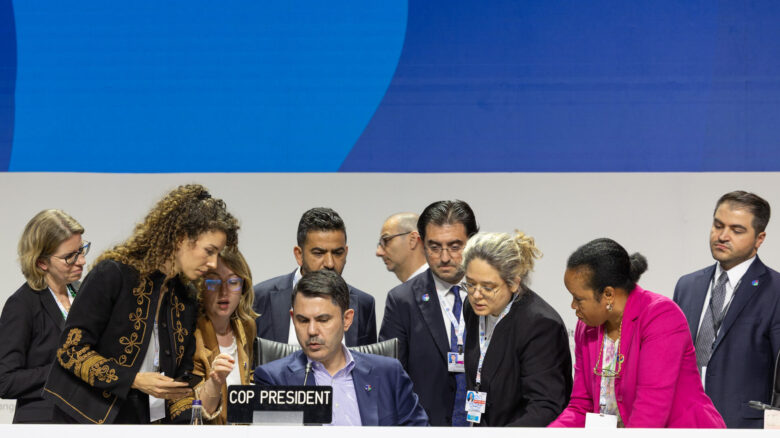
COP31 has entered its second day of overtime negotiations, with the Turkish-Australian Presidency working to secure a final political agreement. After the official deadline of Friday, 20 November passed without a deal, consultations continued throughout Saturday and into the night, without resolving the main differences between the Parties. At the closing plenary, which resumed shortly after 1 a.m., COP31 President Murat Kurum announced that the third and final version of the cover decision would be circulated shortly, once legal checks had been completed. Delegations were asked to indicate their agreement to the text by 6 a.m., ahead of another closing plenary scheduled for the morning of Sunday, 22 November. The third draft was eventually published at around 2 a.m., after several delays from its originally planned release on Friday afternoon. The document contains 94 paragraphs, compared with 144 in the first version of 16 November and 80 in the second version of 19 November. The new proposal restores some references removed in the previous revision, particularly concerning developed countries’ financial responsibilities and just transition, but still makes no explicit mention of fossil fuels and sets no quantitative target for adaptation finance.
Main facts
Third (and final) draft of the cover decision: what has changed from the previous versions. The new version appears to be an attempt to bridge demands for greater ambition and opposition to new sectoral or financial commitments. While retaining the second draft’s focus on implementing existing agreements and international cooperation, the text introduces several significant changes.
- Fossil fuels. The most significant change is the restoration, in the preamble, of a reference to the 2023 Dubai consensus in its entirety, covering mitigation, adaptation and means of implementation. This also indirectly refers to the commitment agreed at COP28 to transition away from fossil fuels in energy systems. However, the text still contains no explicit reference to fossil fuels, their phase-out or the wording “transitioning away”. The absence of explicit language on fossil fuels remains one of the main points of contention for several delegations, including Panama and the 44 least developed countries (LDCs). The Presidency’s compromise therefore appears to reaffirm previously agreed commitments without introducing new obligations or specific guidance on energy sources.
- 35% electrification by 2035. The 35-by-35 initiative, which aims to raise electricity’s share of global final energy consumption to 35% by 2035, is retained. Its connection to other energy priorities has changed, however: whereas the second draft explicitly linked the goal to tripling global renewable energy capacity and doubling the rate of improvement in energy efficiency by 2030, the third replaces these quantitative references with a broader call to expand clean energy, efficiency and low-emission technologies. A new paragraph acknowledges that electrification makes its greatest contribution to mitigation when as much clean energy as possible is used, without requiring all additional electricity to come exclusively from renewable sources.
- CO₂ capture and removal. Support remains for the deployment of carbon capture, utilisation and storage (CCUS) technologies, one of the most contentious issues in the consultations. The second draft included several bracketed quantitative options providing for an expansion of capture capacity to as much as 2.5 billion tonnes of CO₂ a year by 2035. The third version removes these specific numerical targets, replacing them with a collective ambition to achieve gigatonne-scale capacity by 2035. It also continues to recognise the role of technologies that remove CO₂ from the atmosphere (CDR), while specifying that their use must complement, rather than replace or delay, deep emissions reductions. Including a target for these technologies without explicitly mentioning a transition away from fossil fuels may remain a source of disagreement among the Parties.
- Overshoot and climate ambition. The third draft reaffirms the goal of limiting global warming to 1.5°C and acknowledges that temporarily exceeding this threshold (overshoot), as well as any further temperature increase, will heighten the frequency and severity of loss and damage, with some irreversible consequences. The commitment to limit both the magnitude and duration of overshoot remains, with stronger language on the need for deep, rapid and sustained emissions reductions consistent with 1.5°C pathways. However, the first draft’s explicit call to bring warming back below this threshold as soon as possible during the century has not been reinstated. The text thus maintains the scientific and political importance of exceeding 1.5°C without attaching new quantitative mitigation obligations.
- Adaptation finance. One of the main negotiating issues remains unresolved. The third draft does not reinstate the target of at least $120 billion a year by 2035, included in the first version and sought by several developing countries. It retains the reference to the commitment to at least triple adaptation finance by 2035, but does not establish a baseline against which to calculate the increase. The text continues to task the Standing Committee on Finance with identifying possible methodologies and baselines, with a report due in 2027, and proposes discussing a pathway to implement the tripling under the climate finance work programme. The request by the 44 least developed countries to use 2025 as the baseline year has therefore not been accepted. The Antalya–Addis Ababa roadmap on finance for adaptation and resilience also remains, aiming to identify predictable and growing sources of funding, innovative instruments and mechanisms to facilitate access to finance, with outcomes to be presented at COP32. Unlike previous versions, however, the roadmap no longer explicitly refers to resources for loss and damage.
- Financial obligations of developed countries. One of the main additions in the third version is the restoration of an explicit reference to Article 9.1 of the Paris Agreement, under which developed countries must provide financial resources to developing countries for mitigation and adaptation. The text also emphasises the importance of this support in enabling greater ambition and implementation of climate policies in recipient countries, while noting that other countries are encouraged to contribute voluntarily. The change therefore reaffirms the principle of differentiated responsibilities but introduces no new quantified financial obligations.
- Access to climate finance. The section on the barriers that prevent developing countries from accessing available resources is largely retained. The draft acknowledges difficulties related to high capital costs, fiscal constraints and administrative costs, and calls on multilateral climate funds and development banks to simplify and speed up approvals and disbursements, promote mutual recognition of accreditation and strengthen support for project preparation and implementation. Compared with the second version, the request to reduce co-financing requirements has been replaced by a call for more flexible approaches, particularly for least developed countries and small island states. The provisions retain a practical focus, but remain largely requests and encouragements rather than binding obligations for finance providers.
- Loss and damage. The third draft removes the quantitative figures that, in the second version, highlighted the gap between requests and resources available through the Fund for Responding to Loss and Damage: approximately $2.8 billion requested against $342 million allocated, with only 50% of the $822 million pledged converted into contributions. The revised text simply recognises the importance of adequate and predictable funding and encourages further efforts to increase the Fund’s resources.
- IPCC and the second Global Stocktake. The reference to the IPCC’s “Seventh Assessment Report” has been further weakened. The second draft explicitly invited the IPCC to provide contributions from its three working groups ahead of the second Global Stocktake in 2028. This wording has disappeared from the new version, replaced by a more general invitation to contribute findings from the seventh assessment cycle to UNFCCC processes, including the next global stocktake.
- Just transition and adaptation. The third draft restores a specific reference to just transition, recognising that equitable pathways can help accelerate climate action and deliver more inclusive mitigation and adaptation outcomes, but without introducing new dedicated financial instruments.
- Trade. Language on unilateral trade measures remains watered down. The third draft acknowledges concerns about the cross-border impacts of climate policies, particularly on developing countries, but does not restore the first version’s proposal to eliminate certain trade-restrictive measures by 2027.
Publication of the third draft does not, however, mean that an agreement has been reached. The Parties must still state their positions on the text and the other decisions under negotiation. The plenary scheduled for this morning will be a crucial test of whether the compromise put forward by the Presidency can secure the delegations’ consensus. The text continues to favour work programmes, roadmaps, dialogues and technical reports, postponing the development of some operational tools until 2027 or later. This approach could help preserve multilateral consensus, but raises questions about COP31’s ability to translate existing commitments into concrete, measurable results.
Key statements
COP31 President Murat Kurum: “Only small gaps remain to be bridged for an agreement.” The Turkish minister said: “Our responsibility now is to deliver an outcome, and I believe we will. Only small gaps remain to be bridged.” He then urged countries to focus on consensus rather than national priorities.
President of the negotiations Chris Bowen: “Things worth doing are never easy.” The Australian minister told reporters he remained confident that an agreement acceptable to all countries could be reached. “In my experience, things worth doing are never easy,” he said. “People have strong views, of course, but no one has said to me, ‘Let’s give up and go home.’”
Mary Robinson, former President of Ireland and former UN High Commissioner for Human Rights: “In Paris, we saw strong political momentum, backed by France’s leadership. Today we are in a much worse position, yet the two COP31 Presidencies have not shown the leadership needed.” Robinson criticised the lack of high-level political leadership in the Antalya negotiations, also pointing to COP30 in Belém, where Brazilian President Lula da Silva had personally supported efforts to reach a more ambitious agreement. While acknowledging that Belém had not produced an explicit agreement to phase out fossil fuels, she recalled the Brazilian roadmaps on the fossil fuel transition and deforestation, stressing the importance of direct engagement by political leaders in overcoming negotiating differences.