
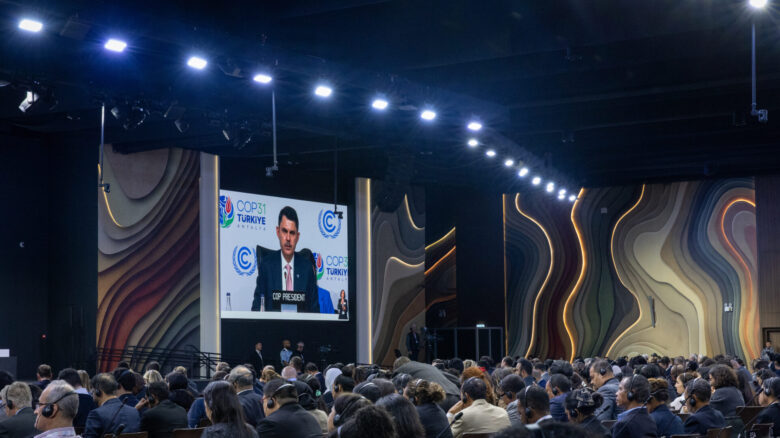
The final official day of COP31 has ended, but the conference is not yet over. With no agreement on the cover decision, the summit’s final political document, negotiations are continuing into the weekend. Following consultations held overnight from Thursday to Friday by the Turkish-Australian Presidency with representatives of the various negotiating groups, a third draft of the cover decision was expected on Friday afternoon, but its publication was postponed, leaving the main political issues unresolved. A plenary session was convened late in the evening to adopt procedural decisions on which the Parties had already reached agreement. Negotiations continued throughout the night, and a new version of the text is still expected today, potentially providing the basis for a final compromise.
Main facts
Friday evening plenary resolves some technical matters while the political agreement remains on hold. Friday evening’s session made it possible to complete several procedural steps and adopt outcomes already negotiated, without resolving the sticking points in the overall agreement. The COP31 President called on delegations to seek a compromise leading to an “Antalya Agreement”, stressing the need to bridge the gap between climate commitments and their implementation. The appeal emphasized the need to reconcile different economic circumstances, energy systems and development needs with the protection of the most exposed communities. The political text is still being negotiated, however, with a third draft expected today and talks set to continue beyond the scheduled deadline. The plenary was briefly interrupted by a protest, after which the Turkish President called for mutual respect.
“The worst COP ever”: civil society rejects the negotiating texts and demands concrete commitments to a just transition. As consultations between the Presidency and negotiators continue, civil society organizations criticize the weakening of ambition in the second draft of the cover decision, the absence of concrete measures to phase out fossil fuels, and the limited attention given to the priorities of the Global South. Their criticisms focus on insufficient financial support from developed countries, the risk of backsliding on the just transition, and the lack of progress on adaptation. The organizations are calling for previously agreed commitments to be implemented without reopening their foundations, and for adequate resources to be made available to countries facing both the transition and growing climate impacts. They are demanding an equitable, fully funded transition backed by verifiable action: in their view, roadmaps that merely repackage existing policies and declarations unsupported by investment are not enough. They are also calling for a shared multilateral outcome that upholds common responsibilities and commitments rather than relying solely on voluntary initiatives.
Italy considers a roadmap for phasing out fossil fuels. At a COP31 press conference, Italy’s Minister for the Environment and Energy Security, Gilberto Pichetto Fratin, said the Italian government could develop a roadmap to phase out fossil fuels, following the example of France and Germany. The Minister announced that the government would conduct an assessment, while emphasizing the need to take account of the particular characteristics of Italy’s energy system. Italy remains heavily dependent on fossil fuels, with different needs and starting conditions from those of other European countries. Pichetto Fratin clarified that the transition is already under way, but gave no timetable or specific targets for any future roadmap.
China and Australia back the 35-by-35 target, but make no reference to fossil fuels. According to Carbon Brief, China and Australia issued a joint statement on Friday reaffirming their commitment to strengthen international climate cooperation and accelerate the energy transition, welcoming the voluntary target of raising electricity’s share of global final energy consumption to 35% by 2035. The two countries also reiterated their commitment to keeping the 1.5°C goal within reach by limiting the extent and duration of any overshoot, and reaffirmed that climate measures should not amount to arbitrary discrimination or disguised restrictions on trade. The statement, however, makes no reference to either fossil fuels or climate finance, two of the main issues still unresolved in the Antalya negotiations.
Key statements
Netherlands Environment Minister Stientje van Veldhoven: “Twenty-five countries have plans to move away from fossil fuels.” At a press conference on the TAFF, the minister highlighted the progress made over the past year in the number of countries announcing fossil fuel transition plans: “If we compare the situation today with last year’s COP, when no country had presented a plan, or with six months ago, when the initiative was launched in Santa Marta and we had only one, it is clear that this is enormous progress.” They include Germany, France, Denmark, Panama, Brazil, Luxembourg, Ireland, the United Kingdom, Sweden, Indonesia, Iceland, Finland, the Marshall Islands, Tuvalu, Vanuatu, Portugal, Norway, Fiji and Spain.
Chair of the African Group negotiators Zanetor Agyeman-Rawlings: “Rich countries must honour their climate finance commitments.” At a press conference, Ghana’s Environment Minister Zanetor Agyeman-Rawlings spoke on behalf of the African Group negotiators: “We urge developed countries to honour the commitments they have already made” on public finance for adaptation and to “provide support through grant-based public finance that does not deepen the debt crisis. A just transition must reflect Africa’s specific realities.” She added: “We came to Antalya seeking a clear pathway to triple the funding allocated. The proposal was removed from the official agenda on the opening day. We did not accept that the issue should end there. Our negotiators have raised this priority in every area of discussion.” She concluded that “African ministers will not accept new obligations unless they are accompanied by adequate finance, technology and capacity-building support.”
Chair of the European Parliament delegation Lídia Pereira: “We cannot accept a text that does not mention transitioning away from fossil fuels.” On Friday morning, Lídia Pereira, chair of the European Parliament delegation, commented on the draft cover decision: “COP31 must be the COP of implementation. Our meetings this week with countries from around the world, from major economies to the most vulnerable island states, have confirmed that Europe has strong partners for this agenda. But while the draft cover decision moves in the right direction on electrification, we cannot accept a text that no longer even refers to what we all agreed at COP28 on transitioning away from fossil fuels.” She then reiterated Brussels’ role in pushing for greater ambition: “As negotiations enter their final hours, Europe must keep pushing, because decarbonization is not only a climate necessity but also our best driver of growth and energy security.”