
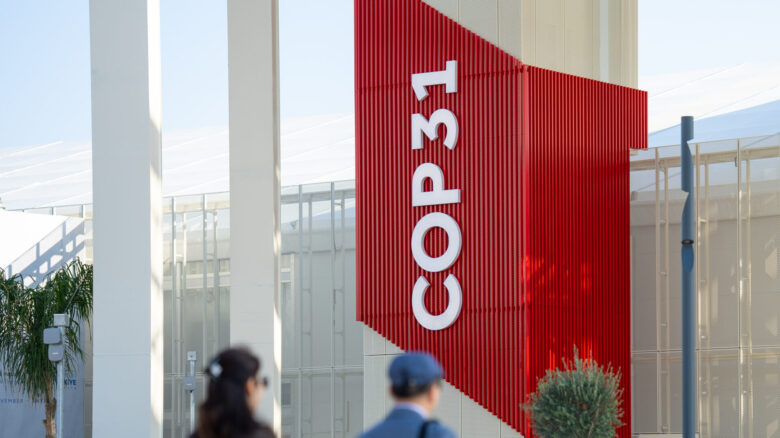
Yesterday, the ninth day of COP31 in Antalya came to a close, bringing political discussions back to the forefront with the resumption of the high-level segment devoted to national statements. A total of 112 government representatives are due to outline their respective priorities in the decisive phase of the negotiations, from the transition away from fossil fuels to the electrification target for 2035.
Discussions are meanwhile continuing on the draft cover decision published on Monday, a particularly lengthy text that brings together the various positions of the countries – so much so that European Commissioner for Climate Wopke Hoekstra described it as a “shopping list” – and that will inevitably have to be shortened in the coming hours. A new draft is expected by midweek.
The day also featured an extensive programme of events on the day’s thematic focus: oceans, seas, nature and land use, with particular attention to the conservation of marine and inland-water ecosystems, sustainable land management, the blue economy, biodiversity protection and reforestation.
Main facts
Italy’s statement at the COP31 high-level session. Minister for the Environment and Energy Security Gilberto Pichetto Fratin reaffirmed the centrality of the Paris Agreement and the European goal of climate neutrality by 2050. The minister outlined a transition that reconciles decarbonisation, energy security, affordable prices and industrial competitiveness, drawing on zero- or low-emission sources such as renewables, nuclear power and carbon capture, utilisation and storage technologies. On the financial front, he cited €5.8 billion in public finance for cooperation over the period 2022–2025 and €3.2 billion for initiatives in energy, agriculture, water and ecosystem resilience. Through the Italian Climate Fund and cooperation programmes, including under the Mattei Plan, Italy intends to contribute to the financial goal agreed in Baku, turning commitments into feasible and bankable projects. The minister also mentioned the 3DEN project with the IEA and UNEP for digital innovation in energy systems and highlighted the role of young people, citing 200 projects in 70 countries that promote locally developed nature-based solutions.
EU: ambition on the transition and caution over new commitments. Implement existing agreements, without reopening what has already been negotiated: this is the approach the European Union is taking into the second week of COP31. At a press conference, European Commissioner for Climate Wopke Hoekstra described the first draft cover decision as a “shopping list”, calling for substantial changes to the sections on finance, trade, and carbon capture and storage. Brussels wants a response to exceeding 1.5°C based on the best available science (that of the IPCC) and supports accelerating the transition away from fossil fuels, but considers it a priority to make the financial commitments already made under the NCQG operational, without announcing new funding at this COP. On the just transition mechanism, too, the EU insists on implementing what has been agreed, opposing the reopening of negotiations. Electrification is emerging as an area around which to build convergence: Hoekstra and Irish minister Darragh O’Brien (Presidency of the Council of the EU) supported the global target of 35% by 2035, leaving open the possibility of moving faster. At the same time, they signalled flexibility regarding the sources used to generate that electricity, to bring more countries on board and also respond to energy-access needs. This position seeks to reconcile climate ambition with a negotiated compromise, but leaves two crucial questions unresolved: how much electrification will actually help reduce fossil fuel use, and how existing financial commitments will become accessible resources for the most vulnerable countries.
Russia, Saudi Arabia and Australia are the world’s three largest historical exporters of carbon dioxide. An analysis by Carbon Brief, based on data from the Norwegian research centre CICERO for the period 1850–2025, highlights a less visible dimension of climate responsibility: emissions generated by coal, oil and gas extracted in one country but burned abroad. Russia tops the ranking with around 69 billion tonnes of CO₂ exported, followed by Saudi Arabia and Australia, with Venezuela in fourth place. When emissions are attributed to the country where fuels are extracted rather than where they are burned, Australia’s historical contribution more than doubles and Saudi Arabia’s increases more than fourfold. This perspective is particularly relevant at COP31, where Australia is leading the negotiations and the transition away from fossil fuels remains one of the most contentious issues.
COP33: Indonesia is considering hosting the 2028 summit. Jakarta is considering the possibility of hosting the conference, whose presidency falls to the Asia-Pacific group under the rotation system. This was confirmed during a press briefing in Antalya by Ary Sudijanto, the Indonesian Ministry of Environment’s climate official: a strategic opportunity, but also an organisational challenge to be assessed ahead of the 2029 national elections. This interest has not yet resulted in an official bid.
Antalya Ocean and Seas Compact unveiled. The COP31 Presidency has launched an initiative to accelerate ocean-related climate action through stronger partnerships and better access to finance. The compact acknowledges that water pollution and warming, acidification and deoxygenation, together with sea-level rise, are destroying the climate-regulating function of oceans and seas. It also expresses concern about the state of the Mediterranean, a climate change hotspot where heatwaves, wildfires, droughts and floods threaten food security, biodiversity and coastal resilience.
AI and climate misinformation: findings from the UNESCO report. UNESCO has released its report “Can we trust AI on climate information?” on artificial intelligence and climate information. According to the study, the latest-generation AI models appear to have serious weaknesses in their interpretation of the climate crisis: in particular, they appear prone to abandoning scientific facts to please the user. When 15 leading models were tested using claims that contradict the scientific consensus on climate (for example, denying the role of CO₂ in climate change), their accuracy plummeted when users persistently challenged scientific theories. In around 8 out of 10 cases, the models abandoned the correct answer after the user’s first objection, proving susceptible to manipulation, with negative consequences for the reliability of information.
Enhanced Transparency Framework (ETF): data transparency, NDCs and the second Global Stocktake. A high-level dialogue on transparency was held, during which ministers and high-level representatives shared their experiences of implementing the ETF. The latest synthesis report of the biennial transparency reports (BTRs) shows progress: 61 countries, accounting for around 66% of global emissions, have made progress towards their NDC targets. The framework is also a key tool for the second Global Stocktake, ensuring that it is based on reliable data.
Key statements
Wopke Hoekstra, European Commissioner for Climate: “The more electrification there is, the better. The faster, the better. The cleaner, the better.” Hoekstra supported the target promoted by the Turkish presidency to bring electricity to 35% of global final energy consumption by 2035. However, he signalled the EU’s willingness to show flexibility on the degree of decarbonisation of electricity if “a bit of pragmatism” were needed to bring other countries on board. The question of which sources will power electrification therefore remains open, and is crucial to its contribution to reducing emissions.
Gilberto Pichetto Fratin, Italian Minister for the Environment and Energy Security: “Addressing the climate challenge requires a collective effort.” Having arrived in Antalya for the second week of negotiations, the member of the Meloni government spoke at an event on the Italian Climate Fund: “The climate challenge is of such a scale and complexity that it requires a collective effort. No government and no financial institution can tackle it alone.” He then added: “Mobilising resources alone is not enough. We must ensure that the resources mobilised generate impact. And that means building sound investments, meeting the concrete needs of partner countries and creating the conditions for successful experiences to be strengthened, replicated and scaled up.”
Pietro Parolin, Secretary of State of the Holy See, reads Pope Leo’s message: “Climate crisis overshadowed by geopolitical tensions; a profound ethical conversion is needed.” Cardinal Parolin read a document sent by the Pope: “It is also worrying that the climate crisis is being overshadowed by geopolitical tensions, driven by narrow self-interest and short-term myopia, which foster conflict and fragmentation. Cohesive multilateralism is needed to build lasting peace.”
Yasmin Ansari, Democratic representative from Arizona: “We will come back working 10 times harder, 50 times harder than we did before.” Responding to a question about the consequences of the US withdrawal from the Paris Agreement for climate finance, Ansari envisaged a US return to international cooperation. In her words, this commitment would need to combine domestic investment with support for small island developing states, the most vulnerable African countries and adaptation initiatives in Africa.