
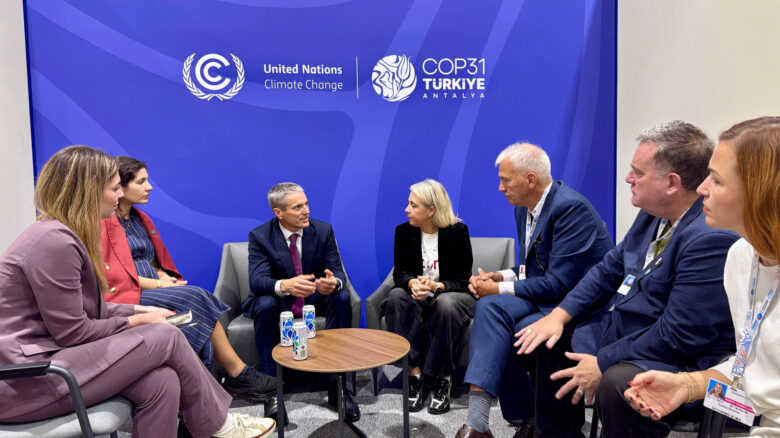
The fifth day of COP31 marks the shift from the Leaders Summit to discussions on the texts, as consultations between delegations continue. To guide work on the cover decision, the Presidency has published an informal note bringing together the positions expressed by countries: not yet an agreed draft, but a basis for discussion that highlights differences over the energy transition, finance and countries’ respective responsibilities. Alongside the negotiations, the day focuses on finance and trade, with attention to climate investment for the green transformation, value chains and carbon markets.
Main events
Cover decision, Parties’ positions published in an informal Presidency document. On the morning of 13 November, the COP31 Presidency published an informal note bringing together the positions expressed by countries in the initial consultations on the final political decision. This is not yet a negotiating draft or an agreed text: the document does not indicate consensus among Parties or show how much support each proposal received. The principles cited include a transparent process, led by Parties and based on consensus, respect for national circumstances and a commitment to multilateralism. Several delegations also call for recognition of historical responsibility for emissions and shortfalls in finance from developed countries.
On mitigation, the note includes proposals to limit the magnitude and duration of the overshoot of 1.5°C, accelerate emissions cuts and submit NDCs aligned with that goal. It refers to the transition away from fossil fuels, the elimination of fossil fuel subsidies, Brazil’s roadmaps on energy and deforestation, and the goal of increasing electricity’s share to 35% of final energy consumption by 2035, alongside renewables and efficiency. The EU, the United Kingdom, Norway and the Environmental Integrity Group (EIG) call for a strong response to overshoot, meaning the exceedance of the 1.5°C global warming threshold above pre-industrial levels, to limit its magnitude and duration and bring temperatures back below that threshold. The Arab Group and the Like-Minded Developing Countries (LMDC) criticise developed countries’ failure to meet their emissions reduction commitments: some countries want the final decision to explicitly require developed countries to reach net zero emissions by 2035 and net negative emissions by 2040. They also oppose imposed targets for sectors and energy sources, including “35-by-35”, which do not account for differences in national circumstances, capacities and development needs. They advocate differentiated national pathways and technological neutrality, assigning carbon capture, utilisation and storage (CCUS) an important role in reducing emissions, particularly in hard-to-abate sectors.
On adaptation, loss and damage, and finance, the document refers to stronger early warning systems, nature-based solutions and a possible programme dedicated to mountain regions. It includes implementation of the global finance goal, with annual targets of USD 300 billion and USD 1.3 trillion, and a pathway to triple adaptation finance by 2035, clarifying the baseline, interim milestones and monitoring. Calls include new contributions to climate funds, simplified access to resources and instruments that do not exacerbate debt. The African Group and the Least Developed Countries (LDCs) insist that the response to overshoot fully address these issues; the LMDC and the Arab Group call for stronger obligations on developed countries’ financial contributions and condemn the barriers created by unilateral trade measures.
Climate finance, the Baku–Belém Roadmap sets out how to reach USD 1.3 trillion a year. The Implementation Report presented by Brazil’s COP30 Presidency quantifies the contribution of different funding sources and shows how much policy choices can influence resource mobilisation. From around USD 261 billion a year in external climate finance for developing countries in 2024, a business-as-usual scenario would bring flows to USD 458–461 billion in 2035, leaving a gap of around USD 840 billion against the USD 1.3 trillion goal. With the identified measures, flows could instead reach USD 1.27–1.41 trillion a year. The largest contribution would come from private investment and a lower cost of capital, reaching up to USD 882 billion, while grants, concessional finance and low-cost capital would rise to USD 342 billion. Carbon markets could contribute USD 40–144 billion a year.
The United States is absent, but local climate action continues. The absence of a US federal delegation at COP31 underscores the importance of continued international cooperation and commitment from local governments. During the press conference, local government representatives reiterated that cities and regions continue to translate the Paris Agreement’s goals into policies and investments, even without national support. California reaffirmed this role through Governor Gavin Newsom, who highlighted initiatives on energy efficiency, low-carbon fuels and clean energy jobs. For Newsom, the discussion must now focus on how to accelerate the implementation of available solutions, tackle dependence on fossil fuels and strengthen accountability for polluting companies.
China will not host COP33. According to The Guardian, after months of deliberation, Beijing has reportedly decided not to bid to host the Conference of the Parties scheduled for 2028. Under the UNFCCC’s rotation rules, an Asian country is expected to host the summit in 2028: the British newspaper reports that Uzbekistan, South Korea, Indonesia and Thailand are considering possible bids.
Small island states, a USD 3 billion adaptation fund financed through migrants’ remittances. The Small Island Developing States (SIDS) group has announced plans to establish a fund financed by a levy on remittances sent home by migrants living abroad, with the long-term aim of raising around USD 3 billion a year. The fund will support projects to make these nations less vulnerable to climate change. Next January, SIDS leaders will continue discussions with development banks to try to launch the project ahead of COP32.
Key statements
António Guterres, United Nations Secretary-General: “Face the facts. Follow the science. Choose the future. And never give up”. Speaking for the last time as Secretary-General, just weeks before the end of a term lasting almost ten years, Guterres presented himself as a witness to the truth about the climate crisis, which he believes is spiralling dangerously out of control and requires countries to step up their efforts on all fronts. “I have tried to tell the truth about climate change,” he said. “Sometimes that truth has been uncomfortable, sometimes unwelcome. But my responsibility has never been to make the facts more convenient: it has been to tell the truth grounded in science, and to be especially clear when the truth is difficult.”
Al Gore, former US Vice President: “Move away from the consensus model”. The former US Vice President called for reform of the negotiating process at the Conferences of the Parties. “There is growing support for moving away from the so-called consensus model,” he said. “The idea that a single country, such as Saudi Arabia, can block any initiative that the rest of the world wants is literally insane. We are facing the gravest threat to humanity’s future that we have ever had to confront.” According to the Nobel Peace Prize laureate, some countries – such as Russia – are also seeking to sabotage the IPCC’s work by delaying publication of its Seventh Assessment Report (AR7) until 2029, rather than the originally planned 2028.
Fitsum Assefa Adela, Ethiopia’s Minister of Finance: “Commitments will be judged not by the targets announced, but by the resources actually delivered”. Speaking about climate finance, the Minister explained that reaching USD 1.3 trillion a year is possible, but not with the current approach: finance must increase significantly, drawing on the private sector, blended finance and every other available source.