
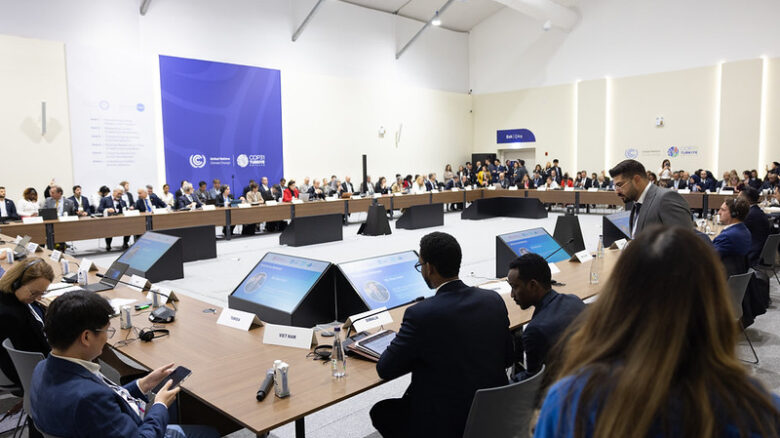
It is the fourth day of COP31 in Antalya, and the Leaders Summit has concluded amid notable absences and statements of intent. On one side, heads of State and government from developing countries urged the wealthiest and most polluting nations to allocate more funding to address the climate crisis – with small island States stressing the importance of emissions reductions for their very survival. On the other, representatives of the more developed countries (at least those who attended) expressed support for the Turkish presidency’s electrification plan, with few references to moving away from fossil fuels.
Contrary to earlier announcements, no representative of the Italian government took the stage: in addition to Prime Minister Giorgia Meloni, Minister of Foreign Affairs and International Cooperation Antonio Tajani did not travel to Türkiye either, remaining in Rome to address hybrid warfare issues. Minister of the Environment and Energy Security Gilberto Pichetto Fratin will arrive in Antalya next week to follow the final part of the proceedings.
With the conclusion of the conference’s political segment, attention shifts to the negotiations. While the agenda was adopted without particular difficulties, the first differences emerged over the prospect of a cover decision, announced by Chris Bowen, President of negotiations. Not all countries appear to favour adopting a cover decision at the end of the consultations, expressing a preference for alternative, less binding outcomes.
Alongside the negotiations, the day brought together representatives of regions and local authorities, business leaders and other stakeholders around the theme of resilient cities and the built environment, with particular attention to the sustainability of buildings and infrastructure, industrial decarbonisation, smart mobility, sustainable waste management and environmental disaster risk reduction.
Main events
Consultations on the cover decision and initial divisions in draft texts. Consultations on a possible COP31 cover decision continue, but the discussion also concerns whether it should be adopted at all. Russia challenged the procedural basis for the process, citing the absence of a specific agenda item, while other delegations raised questions about the document’s mandate and scope. The Presidency aims to present a synthesis of the consultations by today and collect written submissions by tomorrow, ahead of a first draft expected at the beginning of the second week.
Many negotiating tracks now have a draft text: of the more than 100 agenda items, 11 have been deferred or postponed, 44 have some form of draft and 48 still have none, an entirely normal situation at this stage of the proceedings. According to an analysis by Carbon Brief, some drafts already reveal clear divisions.
In the text on the global goal on adaptation, the preamble (still in square brackets and therefore not agreed) refers to “the era of overshooting 1.5°C”, which would make adaptation more difficult. Further on, three options address the commitment to triple adaptation finance: no text (indicating that some countries do not want finance mentioned at all in this section), moving the discussion to the separate work programme on climate finance, and setting a baseline of US$40 billion in 2025, to rise to US$120 billion by 2035.
In the draft mitigation work programme, meanwhile, the disagreement concerns the duration of the process itself: whether it should run until 2030 or 2040, with possible interim reviews. Also appearing in square brackets is Switzerland’s proposal to establish a “mitigation committee”, a permanent body with a standing item on the COP agenda dedicated to emissions reductions: it is unclear whether the idea will be put into practice, but its inclusion in the text is already significant.
Just transition: support for implementation without new obligations. During the consultation on the Just Transition Work Programme (JTWP), interventions by countries aligned with the G77 and China revealed convergence on the need to translate national priorities into implementation through adequate finance, technology transfer and capacity-building. The programme must support country-defined pathways, respecting equity, sovereignty and national circumstances, without imposing policies or further burdens. The Like-Minded Developing Countries (LMDC) insist on the JTWP’s mandate: to facilitate discussion on just transition, without introducing new responsibilities to be assessed or becoming a mechanism for reviewing national policies, that the Global Stocktake (GST) already provides. The focus on the programme’s facilitative and non-prescriptive nature also recurs in other interventions. Within AILAC, Colombia emphasises links with national climate strategies; more broadly, calls emerge for operational support and community participation in defining pathways. The Holy See recalls the “human face of the climate crisis”: the transition concerns dignity, solidarity and shared responsibility, especially towards those who suffer the greatest impacts despite having contributed the least. It proposes a people-centred approach, attentive to ecological and ethical dimensions, and highlights education as a “fourth pillar” of climate action. The Russian Federation reiterates that the JTWP must facilitate dialogue without assessing national policies or introducing universal indicators. It challenges prescriptions on fossil fuels and industrial restructuring, calling for attention also to economic diversification, employment and adaptation, and opposing the legitimisation of discriminatory unilateral trade measures.
Knowing the risk is not enough: resources are needed to protect people. Speaking in the press room alongside Greta Thunberg, Nepali parliamentarian and hydrologist Sagar Dhakal recounted his experience in rescue efforts following the disaster that struck the Bhote Koshi valley, along the Nepal–Tibet border, in August. “I do not think there are words in the dictionary to describe it”, he said. His intervention highlighted the gap between scientific knowledge of hazards and the practical ability to address them: according to Dhakal, a study published six months earlier had already flagged the risk. The parliamentarian cited the case of Blatten, Switzerland, where monitoring had enabled the village to be evacuated before the landslide, contrasting it with the lack of resources for prevention in Nepal. Scientific information must be accompanied by funding for monitoring, early warning and community protection. The gap also emerges from the new report by the World Meteorological Organization (WMO) and the United Nations Office for Disaster Risk Reduction (UNDRR): 136 countries, around 70% of the total, report having multi-hazard early warning systems, but fewer than half demonstrate capabilities across all four necessary components: risk knowledge, monitoring, warning dissemination and preparedness to respond. Investment in forecasting must therefore go hand in hand with strengthening institutions’ ability to act when a warning arrives.
More than US$480 million from philanthropic organisations to reduce emissions of methane and other greenhouse gases. The Leaders-Level Non-CO₂ Greenhouse Gases Summit brought together ministers, international organisations and philanthropic partners to accelerate reductions in emissions of methane and other greenhouse gases apart from CO₂, with the aim of curbing near-term warming and limiting the magnitude and duration of overshooting the 1.5°C threshold. Co-hosted by China and the United Kingdom, with support from the COP30 and COP31 presidencies, the Summit led to the announcement of more than US$480 million in new philanthropic commitments. The programme supports developing countries in translating commitments to reduce superpollutants into concrete action, through technical assistance and institutional capacity-building. UNFCCC Executive Secretary Simon Stiell stressed that acting on methane is among the fastest and most cost-effective ways to slow warming, with benefits also for health, agriculture and the economy. In the oil and gas sector, he recalled, existing technologies could eliminate 70% of methane emissions, largely at low or no net cost. Action on these gases must, however, go hand in hand with rapid CO₂ reductions: it can help buy time, but does not replace decarbonisation.
“Disaster Risk Financing Platform” presented: US$3 billion for emergencies linked to climate shocks. The United Nations launched a new initiative, the “Disaster Risk Financing Platform”, aimed at ensuring access to more than US$3 billion in disaster risk financing instruments to protect 75 million vulnerable people and their livelihoods from potential climate shocks and natural hazards by 2030. Through coordination among United Nations agencies, governments, financial institutions and private partners, the platform aims to strengthen crisis preparedness and anticipatory action, supported by forecasts and early warning systems. Instruments such as contingency funds and insurance coverage can accelerate the availability of resources, helping communities protect crops, livestock and incomes before extreme events turn into food and humanitarian crises.
Key statements
British prime minister Andy Burnham promises: “A new era of UK climate leadership”. The only G7 leader to speak in Antalya, Burnham described the climate crisis as something other than a distant threat: “It is already here, and it is devastating lives and livelihoods everywhere”. He has therefore appointed a special envoy for climate security, entrusting the role to Madeleine Alessandri, former chair of the government’s Joint Intelligence Committee, who will work alongside Katie White, the junior minister responsible for the green transition.
Delcy Eloína Rodríguez Gómez, acting president of Venezuela: “We will defend our sovereign right to responsibly strengthen our oil sector”. In her address, the president of the South American state, appointed on an interim basis following the capture of Nicolás Maduro last January, stated that there is no inevitable contradiction between national energy development and environmental protection, defending her country’s right to expand fossil fuel infrastructure.
Nana Dwemoh Benneh, chief executive officer of the Ghana Infrastructure Investment Fund: “It took a whole village to achieve this accreditation: the future of climate finance must rest on partnerships, capital and concrete projects”. Through this image, he acknowledged the collective work that enabled the fund to obtain accreditation with the Green Climate Fund, opening a channel for direct access to climate finance. This step will allow Ghana to steer investments more closely in line with its own priorities, from renewable energy to water security and infrastructure resilience. Benneh recalled that climate commitments must be followed by capital and partnerships capable of supporting concrete projects: the goal is to translate investment into measurable development outcomes, ensuring transparency and accountability in the use of resources.
Taneti Maamau, president of Kiribati: “Every delay puts lives at risk”. The head of state of the small Oceanian country, directly threatened by the effects of climate change, stresses the urgency of taking decisions: “I urge participants at this summit to act boldly so that COP31 will be remembered for its moral clarity, its unity and its resolute action”.