
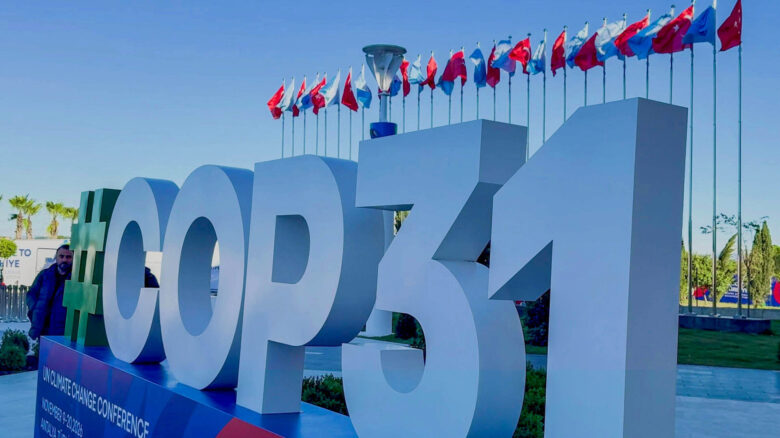
The 31st United Nations Climate Change Conference ended at 7:33 p.m. (local time), without a final political agreement. Although negotiations continued until Sunday, 22 November, the Parties failed to reach consensus on the Antalya Pact, the political decision proposed by the Turkish-Australian Presidency, which addressed some of the summit’s main issues, from mitigation and climate finance to electrification. Initially scheduled for 9:00 a.m., the closing plenary did not begin until 1:00 p.m. on Sunday, more than two days after the conference’s official deadline, making this the longest COP in thirty years and surpassing the record previously held by COP25 in Madrid in 2019. Turkish COP President Murat Kurum opened the proceedings by declaring that the Parties were “on the verge of adopting a historic decision”, while acknowledging the difficulty of reaching a compromise: “Nobody got everything they wanted, but everyone can find something of themselves in this text. That is what consensus means.”
Rule 16 of the UNFCCC rules of procedure was also invoked repeatedly during the plenary. Under this rule, agenda items on which no agreement is reached are automatically carried over to the next session unless the Parties decide otherwise. However, postponement does not preserve the negotiating progress already made: discussions may start again from scratch, with no guarantee that the drafts developed in Antalya will serve as the basis for future negotiations.
Main facts
Closing plenary begins, with the Antalya Pact on the table. Shortly before proceedings began, a new version of the Antalya Pact was published, expanding from 94 to 98 paragraphs, with mostly formal changes and some adjustments to the negotiating language. The changes include an explicit reference to agreements from previous COPs, from Paris to Belém, and slightly stronger language on the IPCC’s contribution to the 2028 Global Stocktake. On energy, the reference to carbon capture, utilisation and storage (CCUS) was softened, replacing “accelerate” with “increase” the deployment of these technologies. The main contentious elements, however, remained unchanged: the absence of explicit references to fossil fuels, the 35-by-35 electrification target and the lack of a quantified figure for tripling adaptation finance.
The Parties’ reactions: no consensus. Even before the plenary reached the agenda item on adopting the cover decision, several Parties – including the European Union, Panama and Ghana on behalf of the African Group – took the floor to oppose the text. Their critical statements were interspersed with reminders from the Presidency to follow the agenda order, creating tensions and prompting a procedural point from Ghana, which strongly objected to having its intervention interrupted.
Once the Presidency allowed national statements, it became clear that a political agreement might fail for lack of consensus. The European Union took the floor again to formally oppose the Antalya Pact, arguing that it was inadequate and had been presented too late. The EU criticised its insufficient or entirely missing references to science, the 1.5°C goal, limiting overshoot and the transition away from fossil fuels, which were not even mentioned. Panama also rejected the proposal, calling for an explicit reference to renewable energy and criticising the excessive reliance on carbon capture, utilisation and storage (CCUS). For these delegations, the compromise represented a retreat from climate ambition. Ghana, speaking for the African Group, focused above all on the gap between commitments and resources: tripling adaptation finance by 2035 still had no agreed baseline, the Antalya–Addis Ababa roadmap did not guarantee disbursements, and there were no financing targets for loss and damage. It also criticised shortcomings relating to the just transition and the treatment of unilateral trade measures. Despite its dissatisfaction, the Group said it was prepared to allow the text to be adopted in the spirit of the Paris Agreement and multilateralism, while calling for measurable results. In addition to these Parties, other delegations formally rejected the text. The Marshall Islands, Norway, the United Kingdom, Vanuatu and Timor-Leste, speaking on behalf of the least developed countries (LDCs), rejected it as insufficiently ambitious or inadequate in addressing their priorities. Their criticisms focused mainly on weak references to 1.5°C and overshoot, the role of science, and the absence of a baseline for tripling adaptation finance. Vanuatu also invoked climate obligations and human rights, stressing that consensus cannot come at the expense of human lives.
The Russian Federation and the Arab Group took the opposite position, rejecting prescriptive approaches to phasing out fossil fuels and defending differentiated national pathways that take account of energy security, costs and development needs. Russia rejected language on abandoning fossil fuels, arguing that reducing supply faster than demand could lead to higher prices, a shift towards more polluting fuels and energy poverty. It also criticised financing that increases debt and trade barriers. The Arab Group objected to the removal of financial demands and references to developed countries’ historical responsibilities, advocating a range of solutions—including renewables, methane emissions reductions and CCUS—and allowing Parties to select technologies according to their national circumstances.
No agreement on adaptation and mitigation texts. As it moved on to other agenda items, the plenary failed to reach consensus on decisions concerning the Global Goal on Adaptation (GGA), which aims to strengthen resilience and reduce climate vulnerability, and the Sharm el-Sheikh Mitigation Ambition and Implementation Work Programme (MWP), intended to accelerate emissions reductions through cooperation and the exchange of solutions. On the GGA, disagreements centred mainly on implementing the 59 indicators adopted in Belém to measure progress on adaptation, and on the financial and technical support needed to make them operational. On the MWP, Parties were unable to agree on new guidance to strengthen ambition and implementation of emissions-reduction measures. The failure to adopt these decisions concerns new negotiating proposals, not instruments already established, and means that unresolved issues will be deferred to future sessions under Rule 16. The European Union, the Umbrella Group and Switzerland expressed disappointment with the outcome, while reaffirming their intention to continue work on both fronts.
Climate finance: procedural decisions adopted, but no new financial commitments. The Parties adopted decisions on the two-year climate finance work programme for 2027–2028 and on long-term climate finance, providing for continued dialogues, workshops and monitoring activities without setting new quantitative targets. The failure to agree on the Antalya Pact leaves the commitment made in Belém to triple adaptation finance by 2035 without an implementation pathway: neither the process for defining its baseline and implementation arrangements nor the Antalya–Addis Ababa roadmap was approved. The target therefore remains formally in place, but without new instruments to ensure it is achieved.
Just transition: the new mechanism will be defined in 2027. The Parties adopted a decision on the Just Transition Work Programme (JTWP), recognising the importance of linking climate action with worker protections, social protection and countries’ development priorities. The text stresses the need for finance, technology transfer and capacity-building to support an equitable transition, particularly in developing countries. The main outcome concerns the future just transition mechanism, whose operational arrangements will be negotiated in 2027. AOSIS welcomed the agreement while calling for stronger guarantees of financial support and compliance with the 1.5°C goal. Paraguay and Argentina highlighted the specific characteristics of agricultural systems and the need to take national circumstances into account, while Switzerland, speaking for the Umbrella Group, acknowledged the importance of the outcome while noting its limitations. The African Group reiterated the need for an inclusive mechanism capable of addressing the continent’s needs.
Key statements
Maina Talia, Tuvalu’s Minister for Climate Change: “There is still a great deal of work to do. We must phase out fossil fuels through a just transition. Tuvalu cannot do it alone.” Speaking at the COP31 closing plenary, Talia reiterated the need to accelerate the transition away from fossil fuels, highlighting the difficulties small island states face in dealing with the impacts of climate change. The Minister stressed the importance of international cooperation and support for the most vulnerable countries, emphasising that the response to the climate crisis cannot be left to individual states alone. Fiji echoed this message, adding: “You did your best, but we are disappointed; the Pacific will keep fighting.”
Ana Luisa Aguilar Candanedo, chief negotiator of Panama’s delegation: “The atmosphere does not negotiate, science does not negotiate, and we cannot keep waiting.” In the final days of the negotiations, Panama repeatedly and explicitly opposed any negotiating text that did not mention fossil fuels. During the closing plenary, explaining the reasons for definitively rejecting the text, the delegate reiterated: “Our responsibility is not to negotiate for the bare minimum, but to protect the planet. This text is a step backwards from what the climate actually requires. This is not a failure of multilateralism: we must speak the truth to one another in good faith and clearly acknowledge when a text is not good enough.”
Li Shuo, Director of the China Climate Hub at the Asia Society Policy Institute: “Antalya represents a major setback for multilateral climate diplomacy, the most significant failure since Copenhagen.” Commenting on the conference’s outcome, Li Shuo criticised the Presidency’s management of the final stages of negotiations, stressing that “COP31 should have strengthened global climate cooperation despite an increasingly difficult geopolitical context.” He added that China, despite maintaining a relatively low profile, had gained growing influence in the multilateral process. According to the analyst, Beijing now provides continuity and stability in international climate cooperation, but the COP31 Presidency failed to harness its diplomatic influence to facilitate a compromise in the summit’s final hours.
Darragh O’Brien, Ireland’s Minister for the Environment, speaking on behalf of the European Union: “We will not support a decision that fails to reflect the scientific evidence and risks further widening the gap between global climate commitments and the action required.” Speaking at the COP31 closing plenary, O’Brien expressed the European Union’s opposition to the Antalya Pact, judging the text inadequate in light of the urgency of the climate crisis. The EU delegation criticised in particular the absence of explicit references to fossil fuels, the main driver of global warming, and the lack of sufficient action to close the gap between existing commitments and the emissions reductions needed to limit overshoot and keep the 1.5°C goal within reach.