
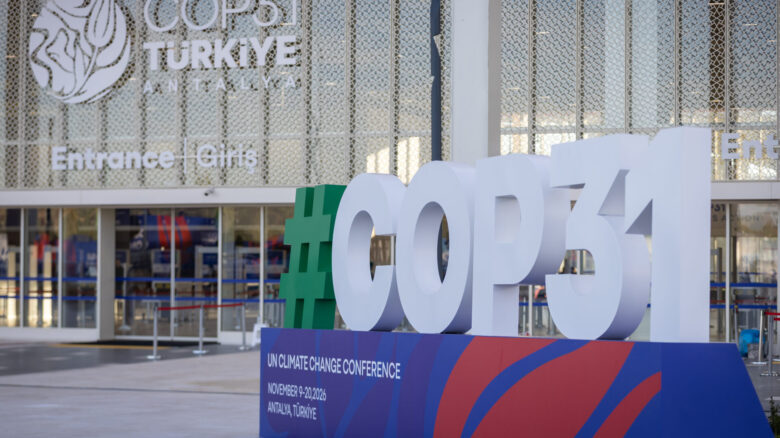
COP31 opened yesterday in Antalya, Türkiye, bringing together delegations from more than 190 countries. The summit is taking place in one of the hottest years on record, and extreme climate events continue to cause severe damage to populations and economies. According to UNEP, limiting warming to 1.5°C with no or limited overshoot is no longer possible. The priority therefore becomes limiting the magnitude and duration of the overshoot and creating the conditions to return below this threshold by the end of the century, although this would not necessarily undo the damage caused in the meantime.
Following the opening plenary and the adoption of the agenda, proceedings focused on agriculture, food security, water efficiency and health. These issues are particularly urgent since there is also the risk that Super El Niño, an intense warming of the equatorial Pacific that alters temperatures and rainfall globally, could worsen food insecurity in several regions of the world, further jeopardising access to food for almost 50 million people. The day therefore centred on the resilience of food, water and health systems, which are essential to protecting populations and their livelihoods.
Main facts
Opening plenary: the spirit of İmece, working together for the climate. The opening plenary marked the handover from the Brazilian to the Turkish presidency. Outgoing COP30 President André Aranha Corrêa do Lago recalled the spirit of cooperation underpinning the Mutirão Decision adopted in Belém, identifying the implementation of commitments as the challenge to be taken up in Antalya. The main decisive issue remains the transition away from fossil fuels and the resources needed to support it. The roadmaps promoted by the Brazilian presidency and the Baku–Belém financial pathway can help guide countries’ action. In a symbolic handover, Corrêa do Lago then presented Murat Kurum with the gavel made from wood from the Amazon, recalling that “this agenda is guided by science, but what we negotiate changes people’s lives”.
Kurum placed climate action within a context of transformation of migration flows, energy systems and supply chains: if crises feed into one another, responses can also reinforce one another. Energy, transport, industry, agriculture and urban development therefore require coordinated action supported by a financial architecture capable of mobilising investment. From this perspective, pursuing climate goals also means creating economic opportunities and strengthening energy security. To express this vision, Kurum evoked İmece, the Anatolian tradition of collective work and mutual assistance for the benefit of the community, inviting countries to share solutions and resources.
The President of negotiations, Australian Minister for Climate Change and Energy Chris Bowen, emphasised the same connection: electrification is a lever for energy security as well as emissions reduction, while finance must make the transition possible. “Working together, we can turn climate commitments into stronger, more resilient and more prosperous economies”, he stated.
This approach is also reflected in the organisation of the proceedings. Kurum and Bowen intend to begin discussions on the final decision as early as the first week: the text that will bring together the conference’s overall political direction. The consultations scheduled for this evening will provide an initial test of the scope for convergence on clean electrification, the transition away from fossil fuels and the tripling of adaptation finance.
EU: 2030 targets still within reach, but faster action is needed. The European Union can still meet its climate targets, provided it fully implements the measures planned at European and national level. This is the finding of the report “Trends and projections in Europe 2026”, published yesterday by the European Environment Agency (EEA). According to preliminary data, emissions fell by 1.6% in 2025, but the pace of reductions in net greenhouse gas emissions slowed compared with 2024. The report therefore highlights the need to accelerate the implementation of mitigation plans to achieve the target of a 55% net reduction in emissions by 2030.
Renewables: energy security accelerates investment. Reducing dependence on imported fuels and protecting against price fluctuations are becoming increasingly strong motivations for the development of renewables. According to the International Energy Agency’s (IEA) “Renewables 2026” report, global renewable electricity capacity will grow by around 4,800 GW between 2026 and 2031, almost 60% more than the additions recorded in the preceding six years. Solar PV will account for more than three quarters of the expansion, followed by wind. Energy market disruptions linked to the war in Iran and stronger support policies are driving faster growth in India, Southeast Asia, Africa and the Middle East. A broader geographical distribution of investment is thus emerging: for the first time in the report’s forecasts, new installations in emerging and developing economies, excluding China, are expected to match those in advanced economies.
Agriculture, women and young people in the spotlight. Two high-level dialogues focused on the role of women farmers and younger generations in the resilience of food systems. The meeting dedicated to women, organised by the COP31 presidency with the Turkish Ministry of Agriculture and Forestry, included the planned presentation of the report “The Unfunded Half”, on the difficulties climate finance faces in reaching rural women despite their contribution to food production and natural resource management. The youth dialogue, organised with FAO, was dedicated to the Antalya Youth Call to Action and youth-led initiatives for more resilient agriculture, with the aim of strengthening access to investment and participation in public policy. Both events centred on the need to accompany recognition of their role with concrete tools to fulfil it.
Health: AIR initiative launched to strengthen the resilience of health systems. Presented on the day dedicated to health, the Antalya Initiative for Health Resilience (AIR) aims to help countries turn scientific knowledge and experience on the ground into concrete policies and interventions. Promoted by the Turkish Ministry of Health in collaboration with the UNFCCC Secretariat and the WHO-hosted Alliance for Transformative Action on Climate and Health, the initiative involves collecting country case studies, fostering exchanges among experts and sharing tools to prepare health services for climate risks. Both successful interventions and the obstacles and solutions that failed to deliver the expected results will be documented, enabling countries to learn from one another’s experiences.
Turquoise Nexus Initiative presented. Led by Türkiye’s Ministry of Agriculture and Forestry in coordination with the COP31 presidency, the initiative is the flagship programme of FAO’s Food and Agriculture for Sustainable Transformation (FAST) partnership and draws on Türkiye’s agricultural experience to integrate food systems transformation, sustainable water resource management and adaptation to climate change. The project aims to move this integration from international debate to implementation, translating it into national political commitments and investment flows.
Key statements
Turkish president Recep Tayyip Erdoğan: “This is no longer the time for making promises that remain only on paper”. In a statement made on the return flight from Azerbaijan, the Turkish head of state identified the implementation of commitments as the priority for the Antalya summit: “Our goal is to make this summit a platform where concrete results are achieved”. A call for countries to take responsibility for turning climate promises into action.
Undersecretary at the Ministry of the Environment and Energy Security (MASE), Claudio Barbaro: “COP31 must mark tangible progress in implementing adaptation measures”. The representative of the Ministry of the Environment and Energy Security, who will speak today at the Baku High-Level Dialogue on Climate Change Adaptation, stressed the need to “translate commitments into action to protect communities and safeguard development prospects, starting with countries’ own priorities”. He then stated that Italy had joined the NAP Implementation Alliance promoted by the Brazilian COP30 presidency to help turn National Adaptation Plans into implementable programmes.
CAN International director Tasneem Essop: “Climate commitments need resources”. At the opening press conference, Essop denounced the lack of new funding from developed countries and highlighted the link between the climate crisis and conflicts. A call to defend multilateralism and give tangible substance to international cooperation.